Drawing games for kids that need nothing but paper and a pencil
By the Scribblie team · Published · 9 min read
In this guide
The best drawing games for kids are the ones where nobody can win by being good at drawing. Squiggle swap, eyes-closed portraits and one-line drawings all work because the results are supposed to look odd. They need paper, a pencil, and about thirty seconds of explaining.
Here are seven, with the rules written out briefly, because a drawing game that takes ten minutes to explain never gets played. After each one we say what usually goes wrong, which you only find out by trying.
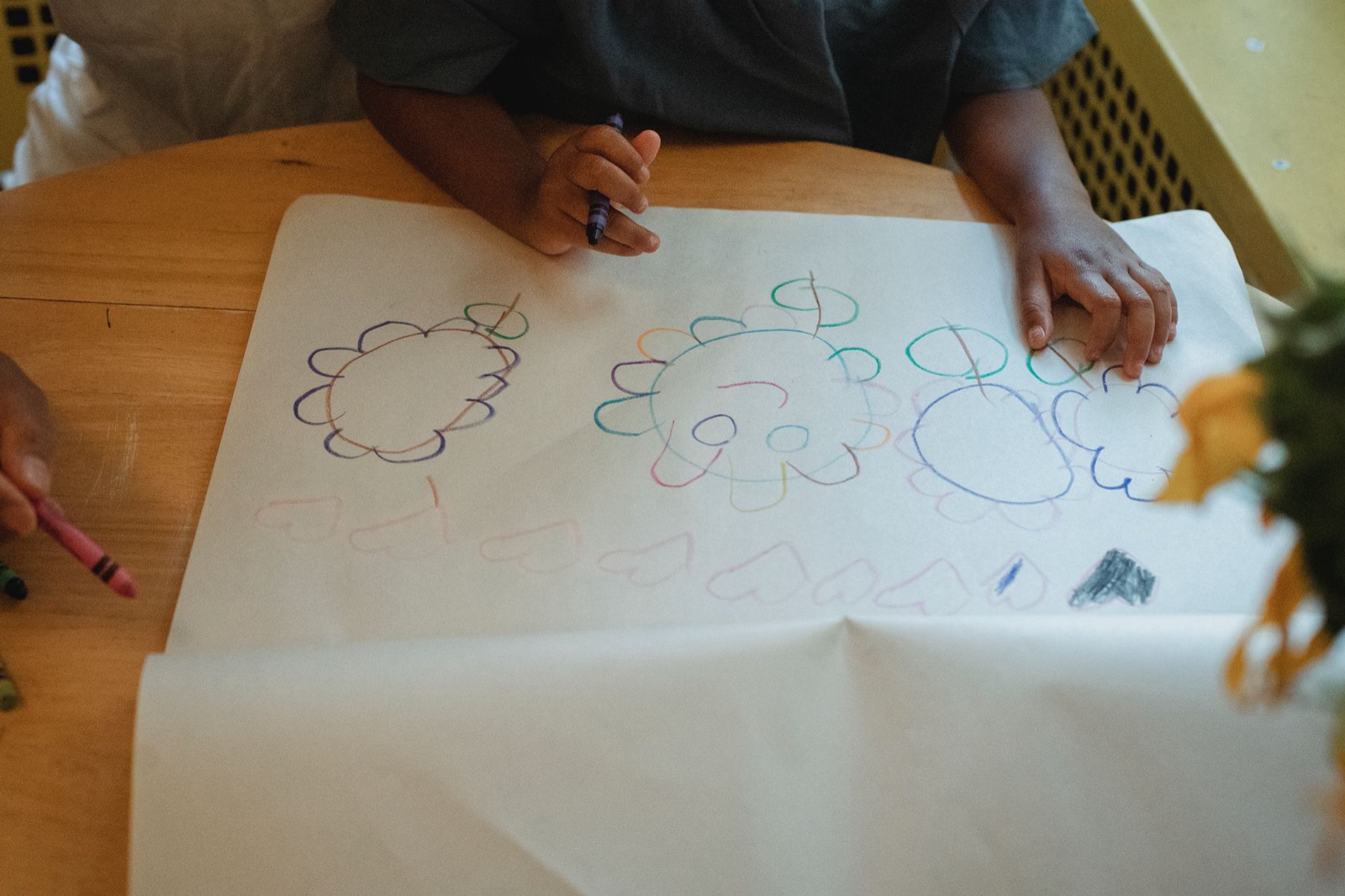
The squiggle swap
Rules: One person draws a squiggle on a sheet of paper. It should be a single wobbly line, with a few loops, nothing recognisable. Hand the paper over. The other person turns it any way they like and makes it into something: a bird, a sleeping bear, a mountain with a face. Then swap roles.
Why it works: a squiggle is a problem to solve, not a blank page, and children are usually good at seeing things in clouds. It is also the quickest way we know to calm a child who says "I don't know what to draw."
What goes wrong: the squiggler makes it too neat, or too tangled. Aim for medium. A squiggle with a clear loop or two gives more to work with than a scribbled knot. If your child gets stuck, turn the paper for them. Seeing the squiggle from a new angle is often all it takes.
For the youngest players, three or four, let them be the squiggler and you do the transforming. They tend to find it hugely entertaining when "their squiggle" becomes a dog.
Eyes-closed portraits
Rules: Players sit facing each other. Each draws the other's face on a sheet of paper, with eyes closed. No peeking until both are finished. When you open your eyes, you show your portraits at the same time.
Why it works: nobody can draw a good portrait with their eyes closed, so the judge is the laughter. It also teaches something real. Without watching your pencil, you notice how much your hand knows, and many players end up with a surprisingly fluid line.
What goes wrong: peeking. It is almost always peeking. Cover the paper with a sheet of card with a hole for the pencil, or use a hand towel over the arm. A child who cheats once in a while is not a villain, they are a child.
Variations. Draw a house with eyes closed. Draw a favourite animal. Draw the person from the other side of the table, but you may keep your eyes open for just the first five seconds. Use a thick marker and big paper if you have it, since small paper makes everything look cramped.
One-line drawing
Rules: Put your pencil on the paper and do not lift it until the drawing is finished. It can cross itself, loop and go back, but there is one continuous line. Pick a subject out of a hat: a cat, a boat, a person running, the family dog.
Why it works: the constraint kills the temptation to fiddle. You cannot erase, so you commit. Many children find this a relief, and the results can look strangely stylish, like something from a gallery gift shop.
What goes wrong: some players find the single-line rule frustrating at first, especially older children who like control. Let them cheat with one lift for their first go and then take it away. Another trap is choosing subjects that are too complicated. A bicycle is a lot. A fish is a gift.
Try this tonight: each person draws the same subject with one line, then you all guess what each drawing is meant to be before revealing. The guesses are usually better than the drawings.
The folded creature
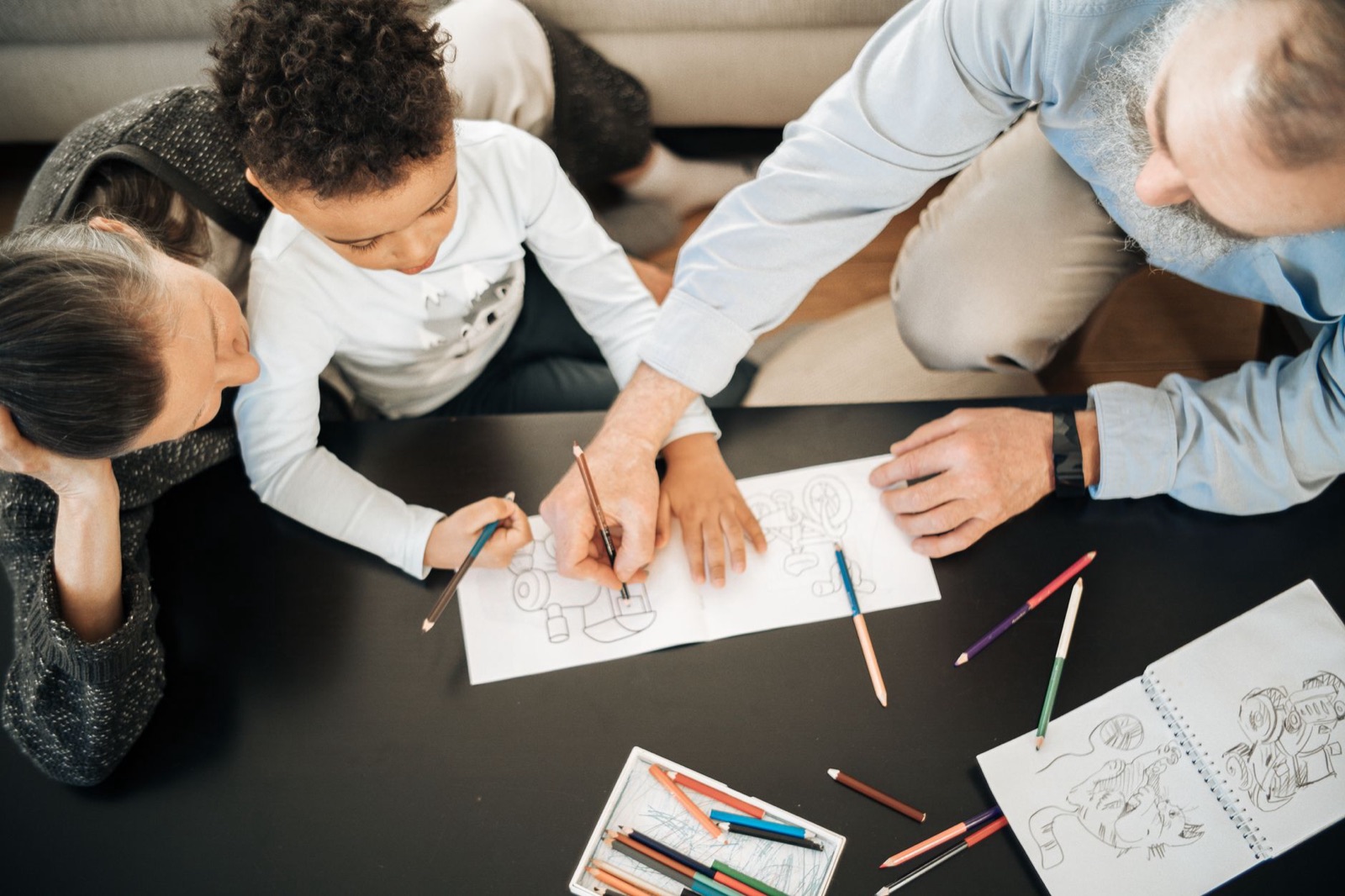
Rules: Fold a sheet of paper into three horizontal strips, like a letter. The first player draws a head in the top strip, letting the neck reach slightly over the fold. They fold the top strip back so the head is hidden and pass the paper on. The second draws a body, with a hint of lines crossing the fold. The third draws legs and feet. Unfold, and show the creature to everyone.
Why it works: nobody knows what the others have drawn, so the result is a mix that nobody planned. The game is old enough that it has a French name that sounds slightly alarming, but it works perfectly well for a five-year-old and a grandfather together.
What goes wrong: children peek, or over-explain what they are drawing. "It's going to be a dragon!" is a spoiler, and after the first round, you can have a rule that nobody announces anything. Another common bump is that the creature ends up in three sizes. Agree on a rough scale first, such as "the whole animal fits on the page".
When a creature is finished, give it a name and a favourite food. That is half the fun and the start of a story. Our guide to the draw-a-monster game has a lot more about how far this one can be pushed, and so does the page on family drawing games, if you have a big group.
Back-to-back describe and draw
Rules: Two players sit back to back. One has a simple picture, drawn by an adult beforehand, or made up on the spot: a house with a door on the left, a tree on the right, a sun in the corner with a smile. The describer explains it without saying what it is, using only shapes and positions. "Draw a big square. On top of that, a triangle." The other player draws what they hear. Then compare.
Why it works: it is a communication game in disguise. A child has to find words for shapes and places, and the drawer has to listen properly. The comparison at the end is very funny, because small ambiguities, like "next to" or "on top", turn into big differences.
What goes wrong: describers rush. Slow down, and add a rule that you may repeat any instruction once. Also, for children under six, it can be frustrating to have to describe without naming. Let them say "a house" and then describe the details. For more on how drawing can give a child new words, see our guide to drawing to learn new words.
Pass-the-paper, add one thing
Rules: Start with a simple sheet. The first player draws one shape, such as a lopsided circle. The next adds one thing to it. Pass back and forth, adding exactly one thing each turn, until the page is full or you laugh too hard to continue.
Why it works: nobody is responsible for the whole picture, and the rule of one thing each stops anyone from dominating. A child who is slow and careful and a child who is fast and chaotic can play together without friction.
What goes wrong: grabbing. A keen player draws three things and calls it one. Settle this early: a "thing" is whatever you can draw without lifting the pencil, or something you could name in one word. Sneaky players will test you. That is a sign they are engaged.
A good ending is to ask each person to give the finished picture a title. Titles written by children tend to be more careful and more surprising than anything you would think of.
The thirty-second challenge
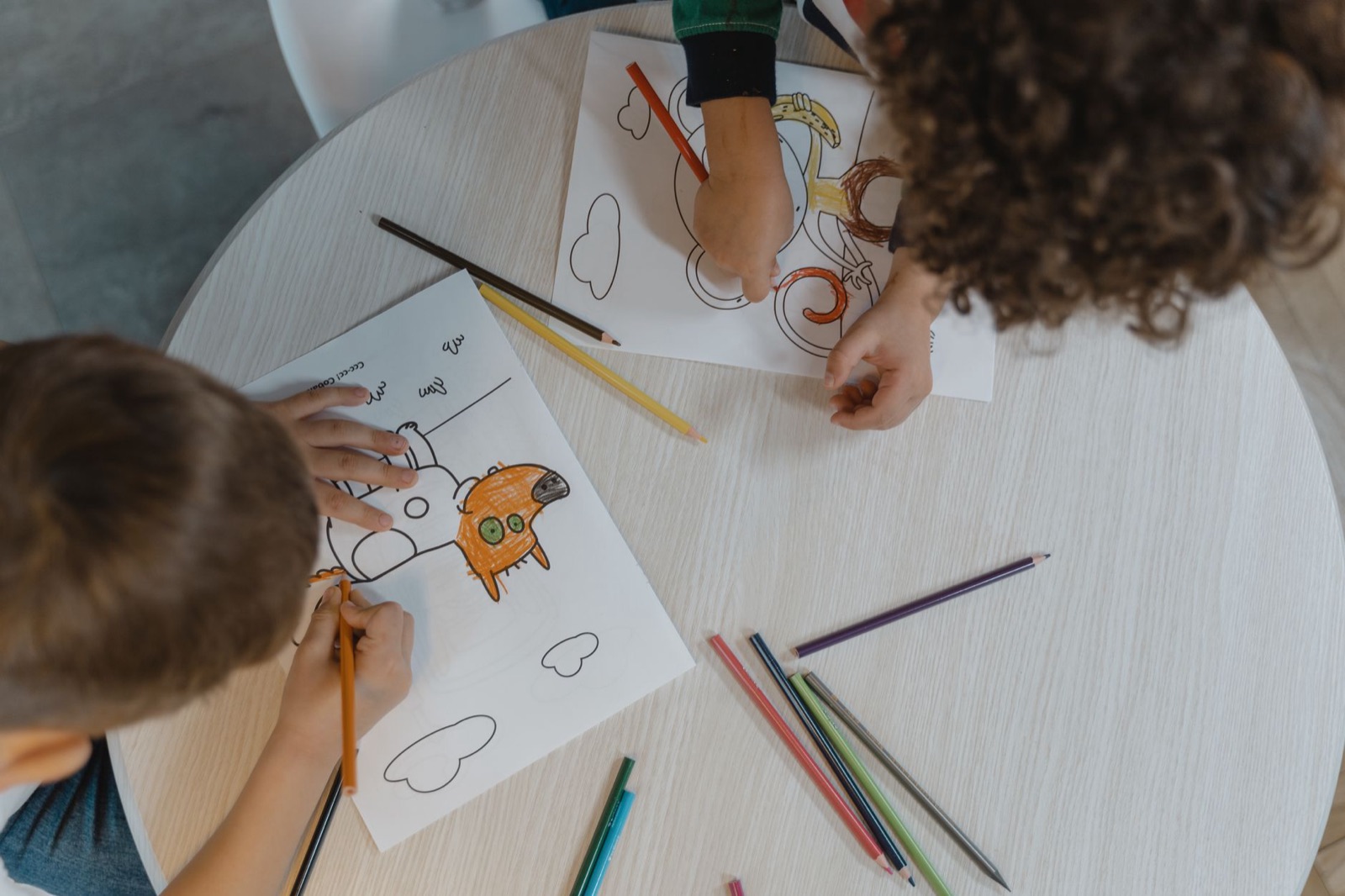
Rules: Someone calls out a subject. Everyone draws it as quickly as they can, with thirty seconds on a timer. Then show each other. Repeat with a new subject. Try to go through ten or so.
Why it works: speed is a different pressure from perfection. Children who freeze at a blank page can often draw at pace, because there is no time to doubt the line. It is also a surprisingly good way of finding out what a child's idea of a "dog" really is, which tends to be a mix of what they have seen and what they have made.
What goes wrong: it is tiring, and it can become competitive. Cap it at ten rounds, and change the rule if it turns into a race: instead of speed, you all draw the same thing, and the funniest one wins, voted by someone who is not playing.
For older children, change the length: draw the same thing in ten seconds, then in a minute, then in five. Compare the three. Many will be pleasantly surprised that the quick one has more life.
Inventing your own game from three ingredients
Once children have played a few of these, they start to invent variants, and it is worth encouraging. Nearly every drawing game is made of the same three ingredients: a limit, a surprise and a reveal.
The limit is what you are not allowed to do. No lifting the pencil, no looking, no talking, only circles, only your left hand. The surprise is the part you cannot control, such as a folded page, a squiggle someone else made, or a subject drawn from a hat. The reveal is the moment you all look at the result together. Games feel flat when one of the three is missing. A game with a limit and no reveal is just homework, and a game with a reveal and no limit is just drawing.
So ask your child to pick one of each. "What shall we not be allowed to do? Where does the surprise come from? When do we look?" A six-year-old who has just decided that the rule is "you have to draw with your tongue out" has invented a game, and you should play it with a straight face.
Some of the best ones we can imagine are quite small. Draw your own hand without looking, then add a face to it. Draw a creature using only the letters of your name. Draw a house, hand it on, and let the next player add the person who lives there and what they are afraid of. None of these needs any special equipment, and none will win a prize.
Keep a small tin of pencils, a sharpener and a stack of scrap paper in one place, and the friction of starting a game drops close to zero. Backs of envelopes and the unused sides of printouts are perfect, and children seem to draw more freely on scrap than on good paper.
Keeping a game going: pacing and mood
Play short. Two to five minutes a round is plenty. Stop on a high, and the children will ask for it again tomorrow. Stop when someone is crying, and they will remember that instead.
Keep scoring out of it. If someone insists on winning, make the prize comic: a "most surprising nose" award, or "the creature we would least like to meet at night". Competitive children can then compete in being silly, and nobody gets hurt.
Adapt up and down. For toddlers, the squiggle swap is the only one that really works, with a grown-up doing the heavy lifting. For ages five to eight, almost everything on the list is fine. For ten and over, add constraints: three colours only, or no straight lines, or draw with your non-dominant hand. We have more age-sorted ideas in the drawing prompts guide.
Be a participant, not a referee. Draw your own wonky versions. A child who sees an adult cheerfully making a mess of a portrait learns more about confidence than any amount of encouragement could teach.
Choose one for tonight
If you only try one, make it the squiggle swap. It takes ten seconds to explain, needs nothing, and almost always produces something that makes a child say "do another one".
Draw a wobbly line on a scrap of paper right now, hand it over, and see what comes back.
Common questions
What are some good drawing games for kids with no supplies?
Squiggle swap, eyes-closed portraits and one-line drawing all need just paper and a pencil. Each takes a couple of minutes to explain and can be played by two people. Start with the one that sounds the sillest to your child.
What is the exquisite corpse drawing game?
It is a folded-paper game where each player draws one part of a creature, folds the paper to hide it, and passes it on. When you unfold it, you get a strange figure no one planned. It started with adult artists but works well for children from about five.
What are the best art games for kids who say they can't draw?
Games where the result is meant to look wrong, such as eyes-closed drawing and the squiggle swap, take the pressure off. Everyone fails together, and the failure is the joke. That tends to loosen up a self-critical child.
How do you play drawing games with children of different ages?
Give younger children a simpler job, such as the middle section or the first scribble, and let older ones handle details. Or handicap the grown-ups with a non-drawing hand. Mixed-age rules are covered further in our family games guide.
Are drawing games good for rainy days or car journeys?
Yes. Most need only a pencil and paper, which makes them easy to carry. For travel, a clipboard helps, and we have a separate guide for car trips.
How long do drawing games last?
Most rounds take two to five minutes, so you can play several in a row. Stop when the laughing slows down, not when the paper runs out.
Keep reading
The draw-a-monster game: rules, variations and why kids love it
Three ways to play draw-a-monster, why children return to it again and again, and how to turn a scribble with eleven eyes into a story.
9 min read
Family drawing games for a long evening (ages 4 to adult)
Mixed-age drawing games for a long evening, with the rules written out, a sensible handicap system for adults and a running order for the night.
9 min read
Drawing prompts for kids, sorted by age (3 to 12)
Sixty-odd drawing prompts sorted into four age bands, with the reasoning behind each so you can invent your own when these run out.
9 min read