The draw-a-monster game: rules, variations and why kids love it
By the Scribblie team · Published · 9 min read
In this guide
- Why monsters are such good practice
- The basic game: one rule and a timer
- Version one: the dice monster
- Version two: the monster with a job
- Version three: the folded monster for two or more
- The words that come with monsters
- Turning a monster into a story
- Monster worlds for older children
- When monsters go wrong
- Tonight's monster
- Common questions
"Draw a monster" is the one prompt that almost no child says no to. Nobody can get a monster wrong. There is no correct number of legs, and the more things you put in the wrong place, the better it gets. That makes it one of the most reliable ways we know to get a nervous drawer to pick up a pen.
Below are three ways to play, the words and stories it can produce, and the usual places the game goes off the rails.
Why monsters are such good practice
A monster is a drawing with the pressure removed. A child who is worried about getting a horse right will draw a monster without a second thought, and in doing so will practise exactly the same things: making shapes, deciding what goes where, controlling a line.
There is also something satisfying about having complete authority. Children spend most of their day being told how things are done, and a monster is a small country where they make all the rules. A creature with a fish tail, three noses and a briefcase is a decision, and each of those decisions was theirs.
And monsters are a sly way into big feelings. Many children draw things that frighten them, or things that are cross, or enormous, then put those things on the page where they cannot do any harm. We would not read deep meaning into any one picture. Drawings are not a window into a child's mind, and a scary monster is far more likely to mean "I like scary monsters" than anything else. If something about a child's drawing or behaviour really worries you, their teacher or doctor is the person to talk to.
The basic game: one rule and a timer
You can play the simplest version in the time it takes to find a pencil. The one rule is: the monster must have too much of something. Too many eyes, too many arms, teeth in odd places. Then set a timer for two minutes, draw, and show each other.
The rule works because it replaces "what should I draw?" with a question that has a thousand silly answers. A younger child will cheerfully give their monster eleven eyes and consider the job done. An older one will think about how eleven eyes would be arranged, whether they all blink together, and whether this affects its social life.
If your child enjoys it, play three rounds with a different "too much" each time: too many legs, too many mouths, too much hair. Put the three on the wall in a row and you have an instant gallery.
Version one: the dice monster
For children who like a game with a bit of luck in it, the dice version is the most fun, and it works especially well with children who struggle to decide. You need a die, paper and a pencil. If you do not have a die, ask someone to hold up one to six fingers behind their back.
Decide on a short list of features, and give each number a meaning. For the body, a 1 might be a blob, 2 a square, 3 a triangle, 4 a long tube, 5 an egg, 6 whatever you like. Roll again for the number of eyes, again for the number of legs, again for a special feature such as wings, a tail, horns, a hat. Draw exactly what the dice say. You are not allowed to cheat, and that is the point: the dice make you commit to a monster that you would never have chosen.
Pacing is the thing to watch. The dice version can start to drag if you roll for ten features. Four rolls is plenty for a younger child, and six for an older one. Stop rolling as soon as the monster is interesting.
A good twist is to let the child roll for you. Then you have to draw a monster with three heads, and your child gets to watch the grown-up wrestle with the problem. Children enjoy this more than they would like to admit.
Version two: the monster with a job
This is the version we like best, and the one that keeps going longest. Once the monster exists, give it a job. A monster who works as a lollipop lady. A monster who delivers post. A monster who is a very bad dentist.
Now the drawing has a reason. The postal monster needs a bag, a uniform, and probably a very long arm for reaching letterboxes. The dentist monster might have sharp teeth, which is a bit of a problem. Children will sort out the details themselves, and they tend to make quite sophisticated links between a creature's body and its work.
Extend it with a few questions. Where does it work? Who are its customers? What goes wrong on a Tuesday? A lot of this can be answered by adding to the drawing, which keeps the pencil moving, and it is a gentle way into storytelling. If you are curious how far this can go, our guide to story-starter drawing prompts has a method for turning a picture into a tale.
For older children, give the job a complication: the monster has a job, but it is bad at it for a reason that comes from its body. A monster librarian who is far too loud. A monster lifeguard who cannot swim. The reason becomes the plot.
Version three: the folded monster for two or more
This is a team game, and it takes a bit of organising, but it is worth it. Fold a sheet of paper into three strips. Player one draws the head and folds it over. Player two draws the middle, and folds it over. Player three draws the legs. Unfold, and then everyone looks together.
Two things make it work. First, the folds are what make it funny, so be strict about not peeking. Second, ask the players to leave small marks that cross the fold, such as the tips of a neck or the top of a leg, so that the three pieces can be joined together at all.
After the reveal, the monster needs a name and a habit. "It's a Gorbelstick and it only eats left socks" is a complete creation story, and it came from the combined effort of three people who could not see what each other was doing. For more drawing games that use a similar structure, see drawing games without screens, and the guide to family drawing games for mixed-age groups.
The words that come with monsters
One of the nicest side effects of monster drawing is vocabulary. A child who has made a monster wants to describe it, and the words on offer are good ones: spiky, slimy, enormous, wobbly, translucent, ancient.
You do not need to teach them. Describe your own monster in more detail than usual and let the words drift across. "Mine is covered in tiny scales, it's very shy and it smells a bit like pickles." Children tend to borrow whatever they like.
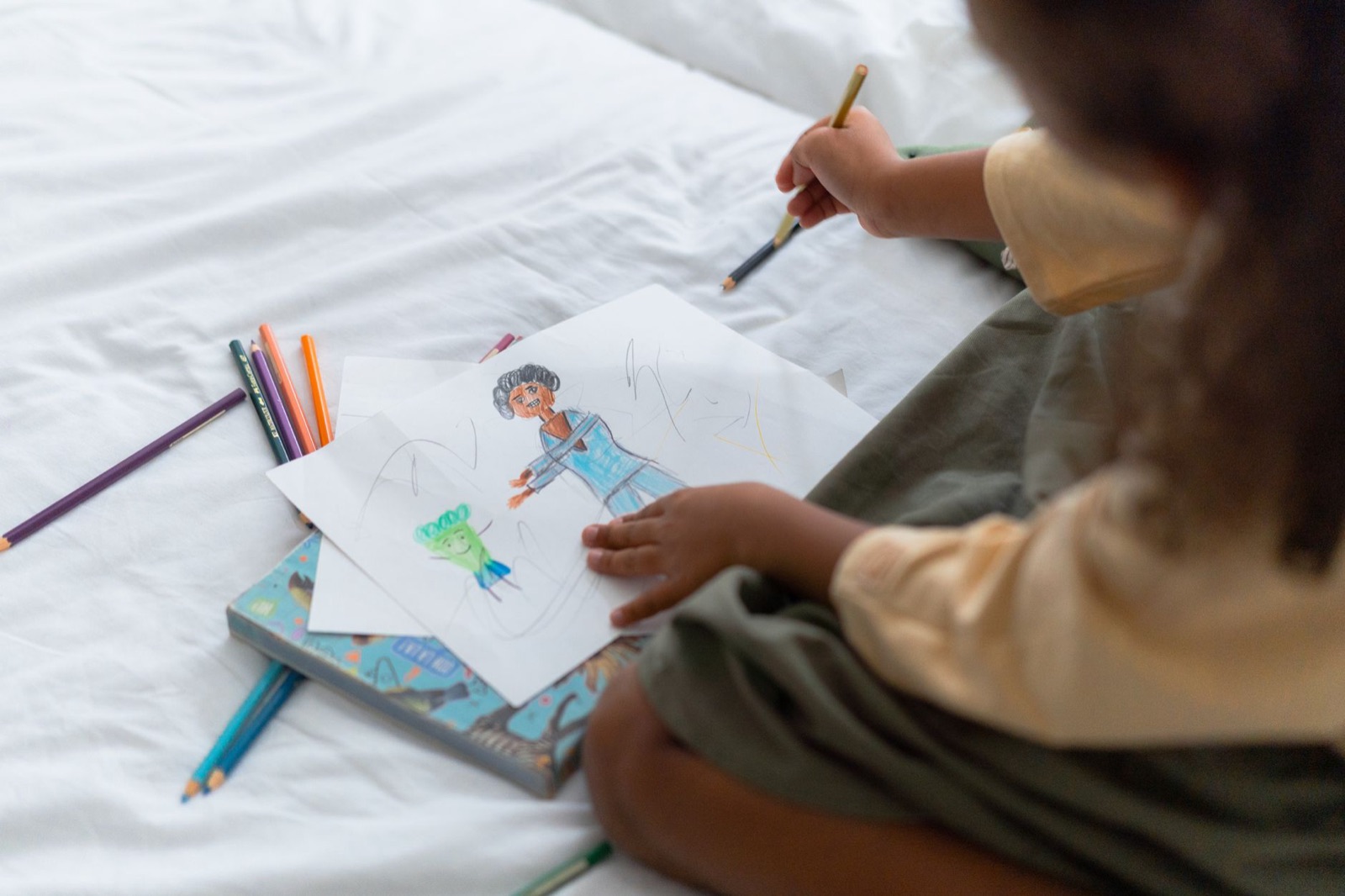
For a child who is learning to write, a label is a low-pressure task. Add a small speech bubble or a name tag, and the writing arrives with a reason. For a child who is not writing yet, they can tell the label to you and you write it down exactly as they say it, including the spelling of "Gorbelstick". The guide on drawing to learn new words goes into this properly.
We would not claim that monster drawing improves anybody's language. We just notice that children who care about their monster tend to talk about it more than they would about a shape or a worksheet.
Turning a monster into a story
Once a monster has a name and a job, the story is already half there. You can ask four simple questions, one at a time, and write nothing down unless the child wants you to. What does it want? What gets in the way? What does it do about that? And how does it end?
A typical exchange might go something like this. "What does Gorbelstick want?" "A sock." "Why can't he get one?" "Because the washing machine is guarding them." "What does he do?" "He builds a ladder out of spoons." You will not need to prompt much beyond that. The questions are a scaffold, and children knock them down quickly.
At bedtime, a monster drawn that afternoon can star in the story. Our guide to bedtime stories from your child's drawing lays out how, and the page on how to help your child tell stories is a good companion.
If your child likes the idea of a monster who answers back, that is a thing Scribblie does too. Scribblie is not yet in the stores, but it is coming to the App Store and Google Play. A child draws on paper and takes a photo, and the drawing wakes up, says hello and asks for its name. The child can then talk to it by voice. Its replies may be generated by AI models, so they can sometimes be a bit off. It extends the same game, the paper version still stands on its own, and you can read the details in how Scribblie works.
Monster worlds for older children
Eight to twelve year olds often want more than a single creature. Give them a bigger frame and they will happily spend a whole afternoon: a field guide, with a page for each monster, a habitat sketch, a note on what it eats and one thing it is afraid of. Many children enjoy giving their monsters weaknesses, which is a surprisingly thoughtful exercise in cause and effect.
A field guide also gives drawing a built-in rhythm. One page a day, five monsters to a week, a cover that gets drawn last. It borrows the structure of a 30-day drawing challenge without the pressure of one, and a child who loses interest in week two has still made something real. Keep the pages in a cheap folder, and let the child decide the order.
When monsters go wrong
A child draws something violent. Monsters eat things, and children know it. We would not overreact to the drawing of a creature gobbling a house. Ask what happens next, and give the story a way for things to work out if you want to. A child who makes the dentist monster nervous is probably working something out, and no more than that.
A child says their monster is better than another's. Take away the contest. Say all monsters are equal, or give each one a power that nobody else has.
A child refuses. Some children will say they do not do monsters, or do not do drawing. Draw one yourself, badly, with a long nose, and leave it on the table. There is a decent chance it will acquire a friend.
Finally, an older child decides this is babyish. Raise the bar: ask them to design a monster for a game, with strengths, weaknesses and a habitat. Plenty of ten-year-olds who would never draw a silly monster will happily draw a convincing one.
Tonight's monster
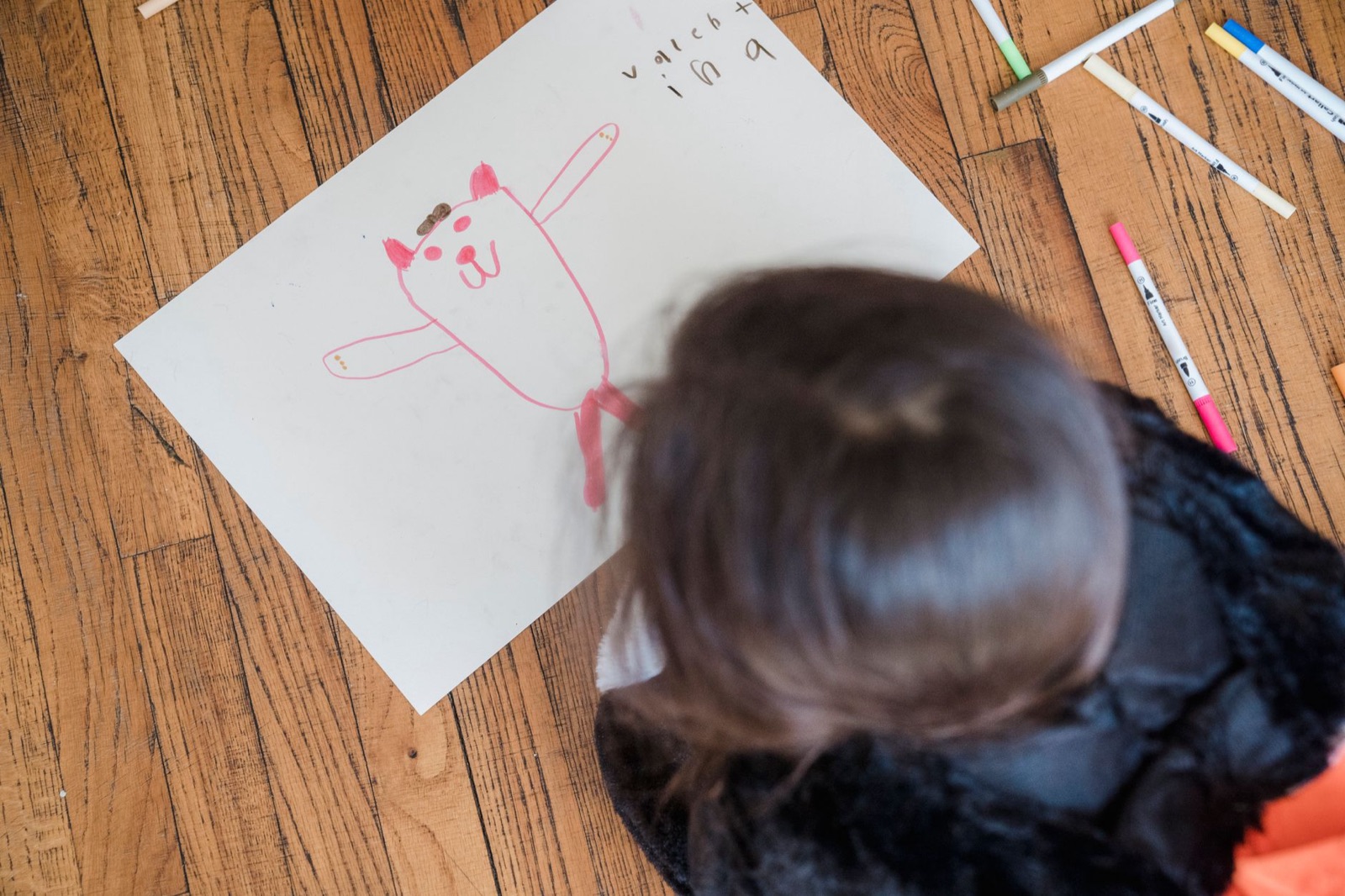
Take a sheet of paper and write one sentence at the top together: "This monster has too much of..." and let your child finish it. Draw it in two minutes, then give it a job and a name.
Pin it up somewhere you walk past. By the end of the week, it will have friends.
Common questions
How do I teach a child to draw a monster?
You mostly do not teach it. Monsters are forgiving because nothing about them has to be right, so say "give it too many of something" and let your child lead. If they want a method, start with a blob body and add features one at a time.
What are fun monster drawing ideas for kids?
A monster with a job, such as a postal worker or a dentist, tends to hold a child's interest longest. A dice monster, where rolls decide the features, is another good one. Folded-paper monsters made by two or three people are the funniest.
Is it okay for kids to draw scary monsters?
Generally yes. Many children use monsters to play with feelings that are a bit big for them, and giving a scary thing a silly hat is a common move. If a child seems distressed or keeps returning to the same frightening image, a calm chat and a word with their teacher or doctor is sensible. A single drawing proves nothing on its own.
What age is the draw-a-monster game good for?
Roughly four and up, with changes. Younger children can scribble a body and add eyes, while eight- to twelve-year-olds can design habitats, weaknesses and rules. The game stretches because the monster can be as simple or elaborate as you like.
How can drawing monsters help kids with writing?
It gives them something they care about to describe, which can make words like "scaly" and "enormous" easier to want. We would not claim it improves writing, but many children happily write a label or a sentence about their own monster when they would not about a worksheet topic.
How do I stop the game turning into a fight about whose monster is best?
Make it cooperative. Draw one monster together, or have a rule that the monsters have to meet and get along. If competition is unavoidable, give out silly awards for categories such as "most eyes" and "best smell".
Keep reading
A 30-day drawing challenge for kids (that survives day 12)
Most daily drawing challenges die around day twelve. Here is a 30-day plan designed around that, with themes by week and an exhibition at the end.
9 min read
Drawing games for kids that need nothing but paper and a pencil
Seven paper-and-pencil drawing games with the rules spelled out, the usual ways they go wrong, and a fix for each.
9 min read
Family drawing games for a long evening (ages 4 to adult)
Mixed-age drawing games for a long evening, with the rules written out, a sensible handicap system for adults and a running order for the night.
9 min read