Left-handed kids and drawing: grip, smudges and setup
By the Scribblie team · Published · 8 min read
In this guide
- Do not force a switch
- The paper angle, which fixes more than you would expect
- Grip: relax and offer options
- Smudge-free tools
- Working top to bottom, and other habits
- Scissors, with a safety note
- Desks, tables and the other side of the table
- Drawing, writing and the school day
- Do not write off a left-handed child's future
- Try this tonight
- Common questions
A left-handed child can draw every bit as well as a right-handed one. What they need is a setup that suits their hand: the paper turned to a comfortable angle, tools that do not smear, scissors that actually cut for them, and nobody trying to change their hand. Most of the trouble people associate with left-handedness comes from furniture, tools and paper that were designed for the other side of the table.
Below is a practical walk through the problems we hear about most, with things to try. None of it is medical advice, and none of it needs expensive kit.
Do not force a switch
Start with the one firm opinion. If your child reaches for the crayon with their left hand, let them. Pushing a child to use their right hand has a long and unhappy history, and we do not know of any good reason to try it.
There is a slight wrinkle: very young children often swap hands. A two-year-old might scribble with the left on Monday and the right on Tuesday, which is normal. Many children show a preference somewhere in the preschool years, though it varies and some take longer. So there is no need to label a toddler as a leftie, or to worry when they swap. Just hand them the crayon and notice which hand reaches for it most often over weeks.
If you are concerned about how your child uses their hands in general, such as if they appear to struggle with both, mention it to their doctor or teacher. That is a different question from handedness, and it is not one a drawing guide should try to answer.
The paper angle, which fixes more than you would expect
When a right-handed child draws a line from left to right, their hand follows the pencil and stays out of the way. A left-handed child going the same way pushes the pencil, and the hand slides over the line they just made. That is the main reason for smudges, and also why left-handers often hook their wrist round into a curl, so that they can see.
The fix is simple, and a bit of experiment is the best way to find it. Try tilting the paper so that its top edge points slightly to the right. This lets the hand rest below the line being drawn, with the pencil pulling and not pushing. Different children like different angles, so offer a few and watch what feels right.
Other things to try:
- Let the child move the paper as they draw. It is allowed. Artists do it all the time
- Place the paper a little to the left of the centre of the body, so the arm is not reaching across
- Give a young child a large sheet taped to the table, which stops it from skidding when they press
- Check the child's view: if they have to bend their neck or crane around their own hand, adjust
Grip: relax and offer options
Left-handed children often develop a grip that looks odd, with the wrist hooked over the top of the line, or the hand curled round the pencil. Adults tend to panic. We would not. A grip that works for the child, that does not hurt their hand and that allows them to see their drawing is a good grip.
If the grip seems cramped, or the child complains of a tired hand, it is worth trying a few things:
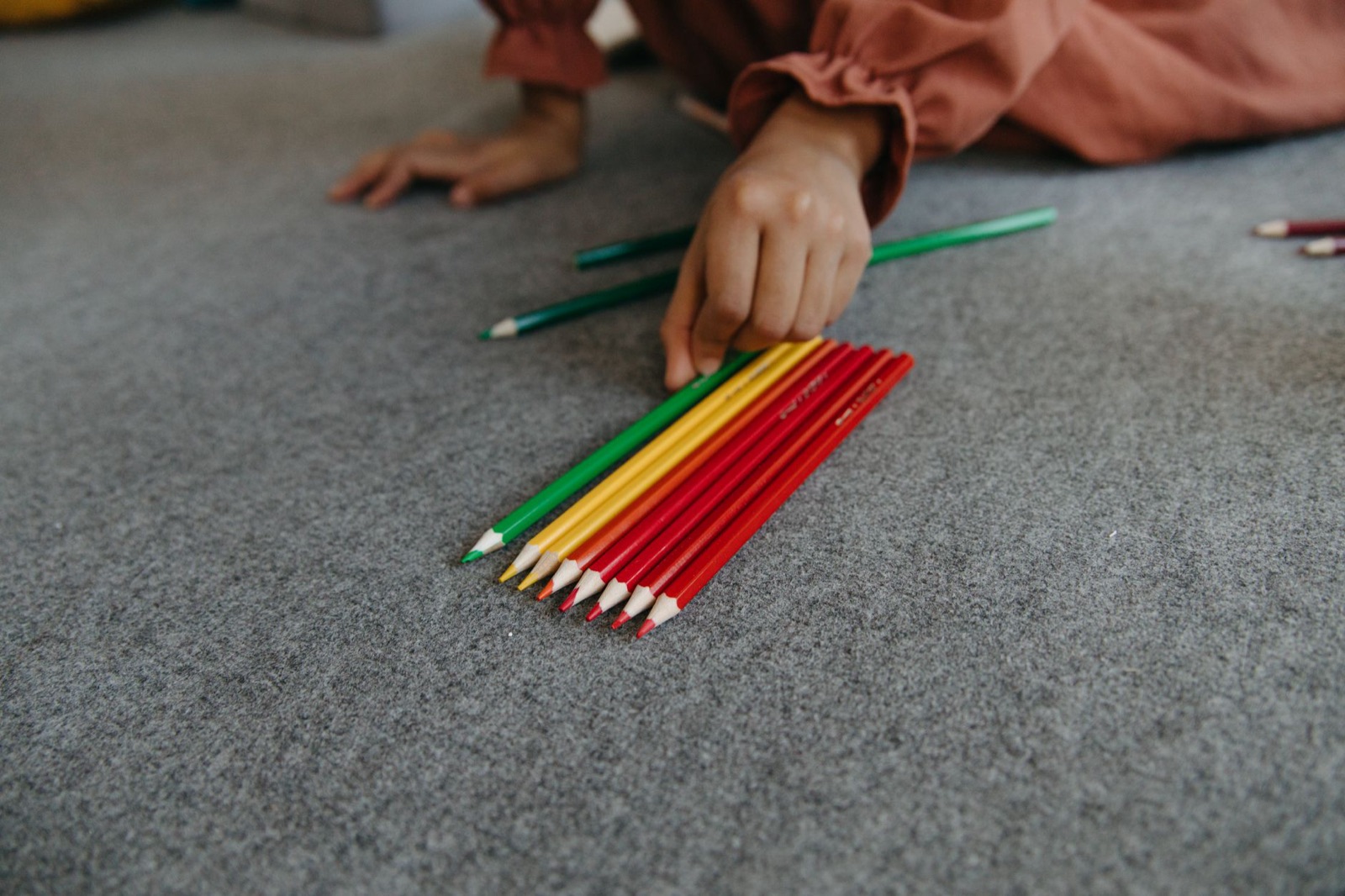
- Chunky or triangular pencils. The shape guides the fingers and makes it harder to squeeze too tightly.
- A grip a little further back from the tip. Holding further up the pencil gives a better view and keeps the hand away from the wet or smudgy part.
- Shorter sessions. A tired hand is a tense hand.
- Vertical surfaces. Drawing on paper taped to a wall or an easel changes the angle of the wrist, and many children seem to find it easier.
Please do not turn grip into a daily battle. We say more about the early stage in what your toddler is really doing with that crayon, where grip is almost always a work in progress. For the very young, the tool matters more than the technique.
Smudge-free tools
Different materials behave very differently for a left-hander. As a rule, anything wet and slow to dry is a problem, and anything that sits dry on the page is easier.
Crayons and wax pastels. Rarely smudge, and they are very forgiving. A good start for young children.
Pencils. Softer, darker pencils smear more. A slightly harder pencil, or a coloured pencil, tends to smudge less. A pencil with a good rubber on the end helps with fixes.
Felt-tip pens and markers. Many dry quickly, which is lovely, but a few stay wet for a while. If your child's hand drags through the ink, look for a quick-drying kind, and try them on scrap paper before buying a large set.
Gel pens and fountain pens. Beautiful but often a nightmare for left-handers, because the ink sits wet. If your child is older and wants to use one, an extra-fast-drying ink and a bit of patience can help.
Chalk and charcoal. Smudge everywhere, for everyone. Useful as a creative feature, less so when you want a tidy line.
For a wider look at what each material is good for, see beyond crayons: drawing materials for kids and what each is good for.
One trick for any tool: give the child a spare sheet of scrap paper to rest the side of their hand on, over the finished part of the drawing. It looks silly, and it works.
Working top to bottom, and other habits
Left-handers can develop little habits that keep a picture clean. None of these has to be taught as a rule. If you notice your child doing something, you can encourage it.
- Drawing the sky first and working down means the hand never crosses wet work
- Colouring from right to left, for those who like to see what they are doing
- Doing the outline first, then waiting a few seconds before filling in
- Turning the page upside down occasionally, to reach a tricky corner from a comfortable angle
Humour helps too. A smudge is not a mistake, it is a cloud. A thumb-shaped grey patch in the corner can be turned into a mountain with two flicks of a pencil, and children enjoy that kind of rescue.
Scissors, with a safety note
Cutting is where many left-handed children really suffer. Standard scissors are shaped for the right hand, and in a left hand the blades can push apart, and the cutting line is hidden by the top blade. The result is a ragged edge and a frustrated child.
Left-handed scissors (or ones advertised as suitable for both hands) swap the blades so the child can see the line. They are cheap enough to be worth trying if your child cuts a lot, and are a small kindness. Look for rounded tips and a comfortable handle.
Safety first, as ever. Scissors are for supervised use, with an adult nearby, and with the kind of age-appropriate pair that suits the child's hands and skills. Young children should not cut unsupervised, and scissors should be put away when the activity is over.
Desks, tables and the other side of the table
A shared table can bring its own problem. If a left-handed child sits on the right-hand side of a right-handed child, their elbows collide. Put them on the left, so that the drawing arms have space.
The same goes for the lighting. A right-hander usually wants light coming from the left, so the drawing hand does not cast a shadow on the page, and a left-hander wants the opposite. If your child is hunched in their own shadow, move the lamp to their right.
A few more things in the setup:
- A table and chair at the right height, so that elbows can rest comfortably
- A non-slip mat or tape under the paper
- Pencils and pens stored in a pot on the right, where the left hand can reach them without crossing the work
- In a classroom, a seat at the end of a row on the left, if the teacher can manage it
None of these is expensive, and some cost nothing but a conversation with a teacher. We think it is worth that conversation. It is far easier to adjust a table than to untangle a child's belief that they are bad at art.
Drawing, writing and the school day
A lot of what makes drawing hard for a left-handed child shows up in handwriting too, and teachers see it. If your child is starting school, it is worth mentioning that they are left-handed, and asking where they will sit and what kind of scissors the classroom has. Most teachers have met the situation before and are glad to adjust.
Do not be surprised if drawing feels easier than writing. A drawing has no right direction, and no line to stay on, so a child can turn the paper and swing round whatever way suits. Writing asks the hand to travel across the page in one fixed way. Keeping drawing joyful gives a left-handed child a place where their hand does not feel like a problem, which is worth a lot. When that child does show you something they made, the advice in how to praise a child's drawing applies exactly the same as for anyone else.
If your child's drawing seems stuck in one stage and you wonder whether handedness is to blame, it is more likely just the ordinary pace of things. Our overview of the stages of child art development shows how much variation is normal, and how a child who draws the same pictures over and over is often busy practising, as we explain in when your child draws the same thing over and over.

Do not write off a left-handed child's future
You may have heard claims that left-handed people are more creative, or more clumsy, or all manner of things. We would not rely on any of them, and we do not know of a dependable basis for them. A left-handed child is a child who happens to use their left hand. They are as likely as anyone to be a joyful, scruffy, tremendous drawer, or a person who would rather build with blocks.
A pair of well-chosen scissors and a tilted bit of paper tell them the world has made room for them.
Try this tonight
Sit down with your child, give them a big sheet of paper and three different tools. Let them move the paper into whatever position feels right, and ask them: "Does it feel better with the paper like this, or like that?" Try it with a crayon, a pencil and a felt-tip. Notice which tool smudges and which one flows.
Then, if something is awkward, do not fix it for them. Ask what would make it easier, and try their suggestion first. They know their own hand better than we do.
Common questions
How should a left-handed child hold a pencil?
There is no single correct grip, but a relaxed one that lets the child see what they are drawing is the goal. Try a chunky or triangular pencil, a hold a little further back from the tip, and a slight tilt of the paper, then let the child settle into what feels comfortable.
How do I stop my left-handed child smudging their drawings?
Move the paper so the hand rests below the line being drawn, and choose tools that dry quickly or do not smear much, such as crayons, harder pencils and quick-drying pens. Teaching your child to draw top to bottom or to rest on a scrap sheet also helps.
Which way should a left-handed child tilt the paper?
Many left-handed children find it comfortable to tilt the top of the page slightly towards the right, which keeps the hand below the line. Try a few angles, because comfort varies from child to child, and let them rotate the page as they go.
Should I try to make my left-handed child use their right hand?
No. Forcing a switch is not recommended, and it tends to cause frustration. Support the hand the child naturally prefers and make the setup comfortable for it.
Are left-handed scissors necessary?
Not for every child, but many left-handers find standard scissors awkward because the blades are set up for the right hand, and the cutting line gets hidden. Left-handed or ambidextrous scissors can help, and cutting should always be supervised with young children.
When do children settle on a dominant hand?
Many children show a preference somewhere between the toddler and preschool years, though it can take a while to become clear. Switching between hands early on is normal, so do not label them too soon.
Keep reading
Stages of child art development, from first marks to realistic drawing
Scribbles, symbols, schemas and the wobbly leap toward realism. A rough map of how children's drawing changes, and what you can safely ignore.
9 min read
The toddler scribble stage: what your child is really doing with that crayon
Disordered, controlled, then named. What a toddler's scribbles are actually doing, which tools are safe, and how to survive the walls.
9 min read
How to praise a child's drawing without killing their curiosity
Skip the automatic "it's beautiful". Here is what to say instead, with example lines for a three-year-old, a six-year-old and a nine-year-old.
8 min read