Tadpole people: how kids learn to draw a person
By the Scribblie team · Published · 8 min read
In this guide
- First, the face
- The tadpole: legs straight out of the head
- How the body arrives
- Hands, fingers and the great finger debate
- Clothes, hair, feet and a world around them
- What to say instead of "you forgot the body"
- Things to do together that quietly help
- Self-portraits are a good trick
- When the same stiff figure appears for months
- What a tadpole cannot tell you
- Common questions
Most children learn to draw a person in a series of surprisingly consistent steps: a round face, then a face with arms and legs sprouting straight from it (the tadpole), then a separate body, then hands, fingers, clothes, a neck, and eventually a figure in profile or in motion. The ages overlap and blur, but the order is a reliable guide, and nearly every step looks like a mistake to an adult and like a great idea to the child.
Below is the route in more detail, along with a handful of things to say that nudge a child toward more detail without ever saying "you forgot the body".
First, the face
Before there is a person, there is a face. Once a child can close a circle (here is why circles come first), two dots and a line turn it into someone looking back at them. Often this happens well before any body appears.
For a long time the face may be the whole portrait. It will probably be enormous, filling most of the page, with the eyes taking up an astonishing amount of room. That is not an error of scale. The face is where all the attention goes when you are small, since faces are what lean over the cot and talk.
Details arrive in an unpredictable order. Some children add ears long before a nose. Some give everyone enormous teeth. Hair is often a burst of spikes. If your child's portrait of you has a tiny nose and giant eyelashes, accept it as an honest report of what they notice.
The tadpole: legs straight out of the head
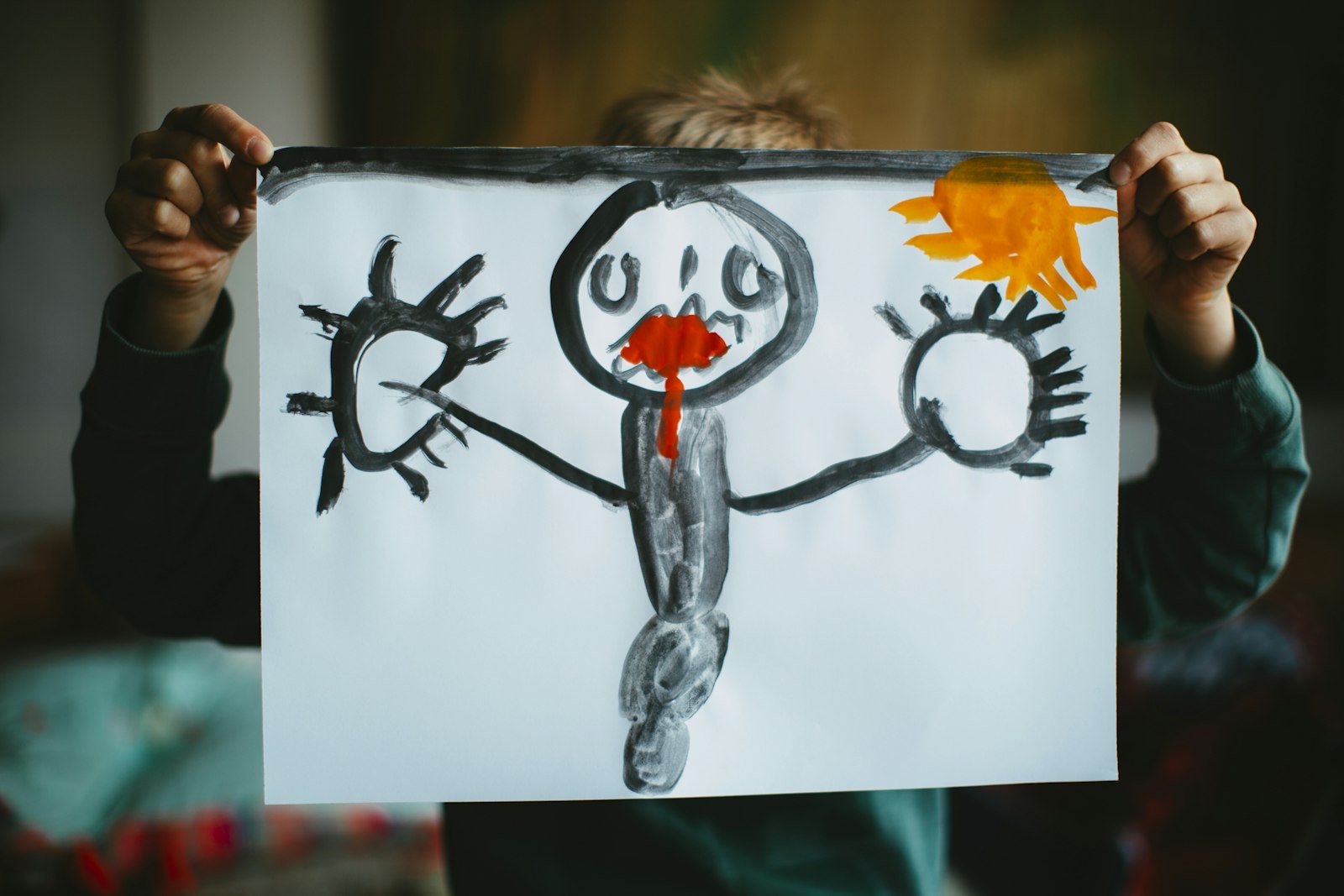
Then comes the famous one. Lines grow from the circle, two or more, and a person walks into the picture. Sometimes the lines come out of the bottom as legs, sometimes from the sides as arms, and sometimes in a splay of spokes that is hard to classify. Adults call these tadpole figures.
The logic is rather lovely once you see it. Think about what a three- or four-year-old really knows about a person. They know the face, because that is how you tell who someone is. They know arms, because arms pick you up. They know legs, because legs walk off to work. The tummy is there, certainly, but nobody ever does anything with it, so it does not get a line.
We cannot give you an exact age for this. Many children make tadpole people somewhere around three to five, some skip the stage quickly, and some stay with it for a long time and then move on abruptly. Please do not hold a ruler up to the calendar.
How the body arrives
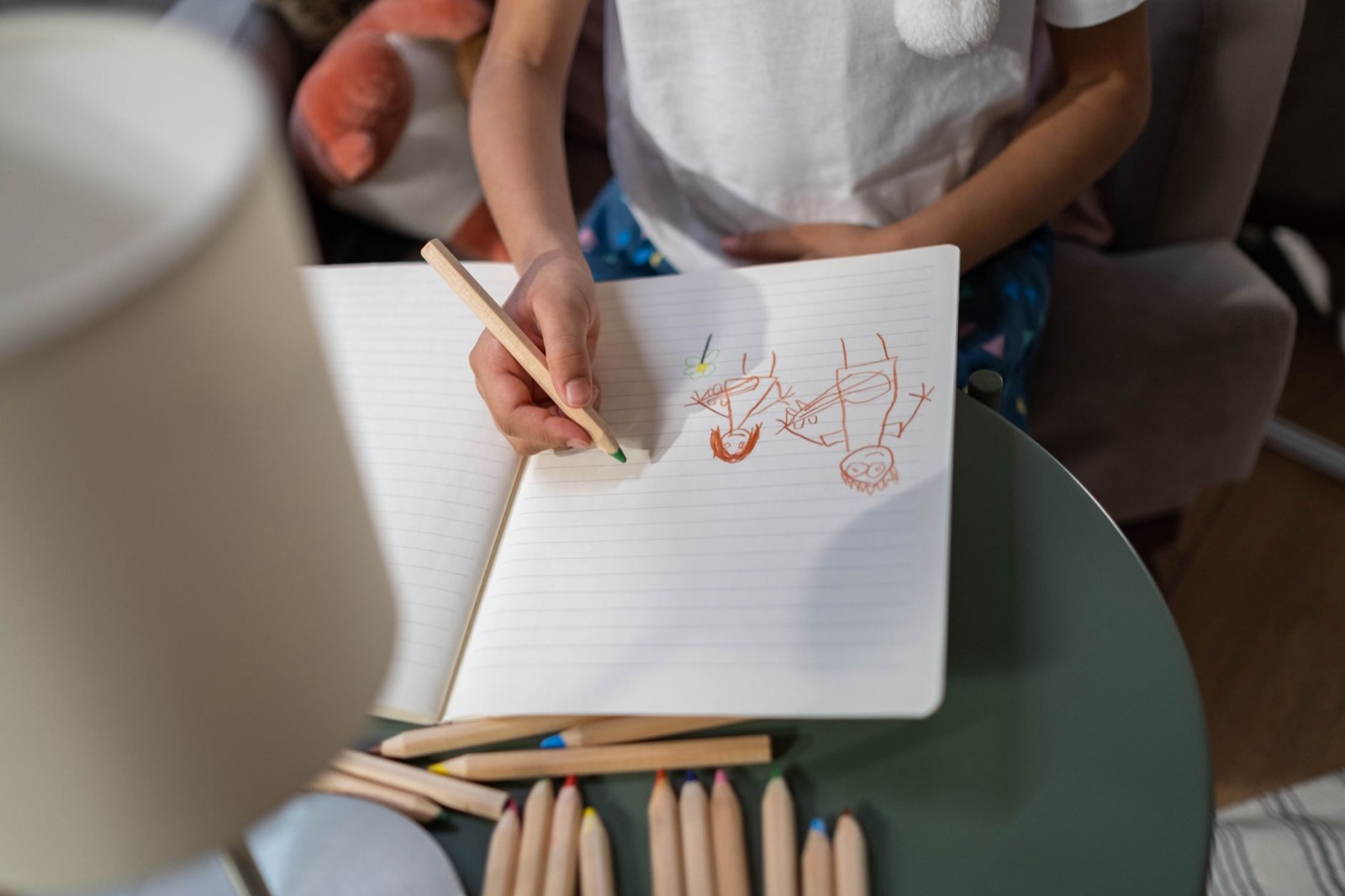
One day the body turns up. It may be a bean-shaped blob under the head, a second circle, a rectangle, or a line with the arms attached halfway down. Sometimes it floats next to the head with a gap between them, as if the child were not sure the two were related. That is normal. They are still working out how the parts join.
You will often notice that the figure is stiff and symmetrical at first, standing straight to attention with arms out like a starfish. There is a good reason: that is the easiest position to draw, and children mostly choose the easiest option that still counts as a person.
At this point, the drawing starts to gain a kind of grammar: heads on top, feet on the bottom, a person has two of everything. Kids who have the grammar can start making jokes with it. A monster with eleven legs only works as a joke if the child knows people have two.
Hands, fingers and the great finger debate
Hands are hard. Anybody who has ever tried to draw a hand knows this, and a child's hand is working harder than an adult's, with less control and no tricks.
So fingers come out in whatever number the child considers sufficient. Seven fingers, three, a sunburst of lines or a paddle are all fine. Fingers are small, they are fiddly, and the number does not hugely matter to a child who just wants it to be clear that the person is waving.
Our favourite thing about this stage is the quiet pride when a child adds fingers at last. They look at the page. They look at their own hand. They wiggle their fingers. It is a small piece of science, and it deserves to be left alone.
Clothes, hair, feet and a world around them
Later, the picture fills up. The figure gets a dress or a T-shirt with stripes, shoes, a hat. Feet may point sideways, since a foot drawn from the front is hard. Hair may be long and flowing. A neck might appear, and it will be a cylinder.
Around five or six, the figure often acquires a ground to stand on and a context: a house, the sun, a pet. At that stage, the figure is part of a little scene, and the scene tends to have a story. It is the point at which we most want to ask about the picture, and it is worth asking well. See our guide to questions to ask about your child's drawing for some options.
Profile views and figures in motion, running or bending, usually come later. A child who has drawn the same front-facing person for years may suddenly produce a side view, nose first, with enormous pride. It is a hard conceptual leap, from "what a person is" to "what I can see of a person from here", and it is related to the wobble toward realism we describe in our overview of the stages of child art development.
What to say instead of "you forgot the body"
The single most useful thing a parent can do is stay curious and keep the verdict out of it. Here is how that can sound.
Instead of: "Where's his body?" Try: "Tell me about this person. What are they doing?"
Instead of: "That's lovely! But people have fingers." Try: "He's waving at somebody. Who is he waving at?"
Instead of: "Is that Mummy?" Try: "Is this someone you know, or someone you made up?"
Instead of: "Let me show you how to draw a person." Try: "I wonder how you'd show that she's running."
None of these is a trick. They are honest questions, and they invite the child to think about the figure a little harder, which is all you were after. Often, the very next drawing arrives with a new detail. A child who has been asked how a person is running may add a bent leg, or lines to show speed, entirely on their own.
If you want specific lines for different ages, our piece on how to praise a child's drawing has scripts for 3, 6 and 9 year olds.
Things to do together that quietly help
You do not need a method. These are just ways to put more people in front of your child's eyes and hands.
- Draw a family portrait each, then swap. Compare, and laugh at your own efforts. Resist the urge to produce a masterpiece.
- Play "add one thing". Draw a circle face, and your child adds a body part. Pass the paper back and forth until the person has a ridiculous number of parts.
- Look at bodies. Stand in front of a mirror and ask your child what they can see. Count elbows. Find knees. Wave, and notice where the arm bends.
- Draw a person doing something. Eating or jumping, say. Actions lead to bending bodies faster than any instruction does.
- Trace a shadow. On a sunny day, chalk around a person's shadow on the pavement. It is an oddly satisfying way to see a body from the outside, with a torso and all.
If you are in the mood for stickers, cut-out paper dolls or jointed puppets, they also help children see how bodies fit together, though we do not think they are necessary. A paper puppet made from a child's own drawing is one lovely way to see a figure move, and often provokes interesting questions about elbows.
Self-portraits are a good trick
Children usually enjoy drawing themselves, and it is a quietly effective way to get more detail into a person. Ask your child to draw what they look like today, then offer a hand mirror. Not so that they can copy it, only so they can look.
Questions like "What colour are your eyes?" and "Do you have freckles?" send the child back to the page with a new idea. You may find that eyelashes, ears or a wobbly fringe appear, and that the self-portrait has more detail than any other person in the picture, which makes sense, because this is the person they know best.
Expect jokes. A self-portrait with a hat made of spaghetti is a self-portrait with a sense of humour, which is a better outcome than an accurate nose.
When the same stiff figure appears for months
It is common for a child to settle on one version of a person and draw it in every picture for a long time. The same arms-out starfish, the same smile. It can look as if nothing is happening.
Something is. The child is practising a reliable symbol, so that they can spend their attention on other things, like what the person is doing and where they are going. We talk about this in our guide on when your child draws the same thing over and over. The figure will change when the child is ready for it to change, and not before.
If you want to widen things gently, give them a reason to draw people differently: a picture of a dance, a race, a person sitting in a very tiny chair. You are offering a new problem, not a correction.
What a tadpole cannot tell you
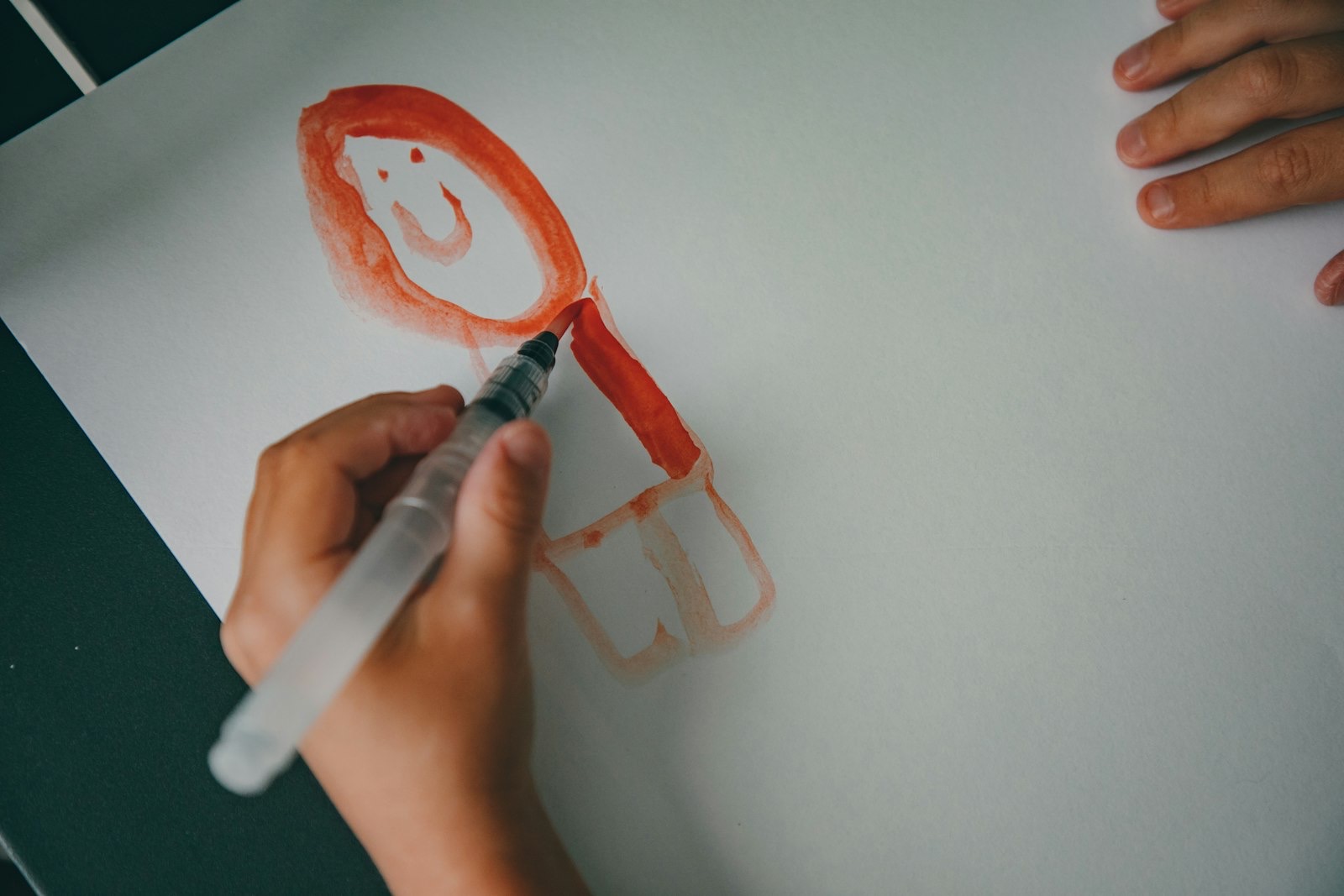
Please do not read a child's personality, feelings or intelligence into the way they draw people. A person with no smile, large hands, no feet or a tiny body is not a coded message. Most of the time the figure simply reflects how far the hand and the idea have got.
If you are worried about your child's wellbeing, the place to look is the child, not the page. Talk to them, and if the worry stays, talk to their teacher or doctor.
Here is a small thing for the weekend. Ask your child to draw your whole family, and put the date on the back. Do it again in six months. Lay the two pages side by side, and you will see more growth than you could ever notice day by day, and you will probably have the funniest picture of yourself on the fridge for a year.
Common questions
What is a tadpole figure in a child's drawing?
It is an early drawing of a person made of a round head with arms or legs (or both) attached directly to it, and no body in between. Many children draw these somewhere around three to five, and it is a normal stage rather than a mistake.
Why does my child draw people without a body?
A young child draws the parts of a person that matter most to them, such as the face, the arms and the legs. The middle simply does not carry much weight yet. Most children add a torso on their own without being told.
How do I teach a toddler to draw a person?
You mostly do not need to. Children tend to get there through their own repeated drawing and by watching others. You can encourage it by drawing alongside them, asking about the people in their pictures and pointing out real bodies in a friendly way.
Should I correct my child when a person has no neck or the wrong number of fingers?
We would not. Correction early on can make a child feel that drawing is a test. Ask about the figure instead, and let your child spot the change they want to make.
At what age do children draw a torso?
Many children begin adding a body somewhere around four to six, though the range is wide. It often appears suddenly, and the first torsos can be oddly shaped or float next to the head.
What does it mean if my child's people look scary or have no smile?
On its own, very little. Children draw people quickly, with whatever the hand can manage, and a mouth is often just a line. If you are concerned about your child's mood, talk to them and to their doctor or teacher, and do not rely on the drawing.
Keep reading
Stages of child art development, from first marks to realistic drawing
Scribbles, symbols, schemas and the wobbly leap toward realism. A rough map of how children's drawing changes, and what you can safely ignore.
9 min read
Why children draw circles first (and what comes after)
Circles are the first shape most children master, and they turn into faces, suns and tadpole people. What it means, and what it definitely does not.
8 min read
How to praise a child's drawing without killing their curiosity
Skip the automatic "it's beautiful". Here is what to say instead, with example lines for a three-year-old, a six-year-old and a nine-year-old.
8 min read