What your child's drawings mean, and what they don't
By the Scribblie team · Published · 8 min read
In this guide
- Why the "decode your child's drawing" lists are so tempting
- What is going on in most drawings
- The weak signals people lean on
- What a drawing can tell you
- How to listen instead of interpreting
- When a worry is real, and where to take it
- Three imaginary drawings and how we would read them
- What over-reading costs
- Common questions
A child's drawing can tell you what they are interested in, how their hand is developing, and what story they happened to feel like telling that afternoon. It cannot tell you, with any reliability, what they secretly feel, whether they are happy, or what kind of person they will be. Anyone who says otherwise, particularly in a list of "what colours mean", is overselling.
If you came here worried, the rest of this guide explains why drawings are such a poor lie detector, what is worth noticing, and where the real help sits.
Why the "decode your child's drawing" lists are so tempting
Parents search for this because they want a window. Children, especially small ones, cannot always say what is wrong, and a drawing feels like the one thing they are willing to give us. So a chart that says "red means anger, a big sun means a happy home" feels like a gift.
The trouble is how little evidence there is behind most such charts. We are not aware of any dependable way to read a child's inner state from a single picture, and we would be wary of anyone who claims one. Drawings are noisy. A child might draw a grey sky because grey was the nearest crayon, or a tiny figure because the paper was nearly full, or a house with no door because they forgot.
There is also a stubborn pattern that makes interpretation worse: once you think you know what a drawing means, you start to see it. A parent who worries a child is lonely will notice the one small figure in the corner and miss the three other pages that were full of people. We all do this. It is a reason to be humble, not a reason to feel foolish.
What is going on in most drawings
Before reaching for meanings, it helps to know what drawings are mostly made of. For most children, most of the time, a picture is the result of four boring-but-powerful things:
- A four-year-old draws people as a head with legs because that is what the hand and head can manage. We cover this in how kids learn to draw a person.
- From about five, children rely on a few trusted pictures (a house, a sun, a tree) and repeat them. See why every kid draws the same things.
- Pens that have dried out, one colour that is always missing, a pencil that is too hard. These choices shape the result more than feeling does.
- A dragon appears because the child watched a film about dragons.
Put those together and most oddities explain themselves. The "sad" figure with a downturned mouth was drawn fast. The "angry" red scribble is red because red is bold.
If you want the longer developmental picture, our overview of the stages of child art development is the place to start.
The weak signals people lean on
Here are the interpretations we see most often. We would give each very little weight.
Colour. Children choose colours for beauty, mood, availability and, quite often, to match the thing they are drawing. A purple cat is not a symptom. If a child uses only one colour, ask whether the other pens work.
Size. A giant dog beside a tiny house is common, and it usually means the dog is what the picture is about. Children draw important things large.
Position on the page. Charts claim that left means past and right means future, or that the top means hope. Children mostly put things where there is room.
Missing parts. No hands, no neck, no nose. At many ages these are normal, because the child has not yet added them to their schema. A missing body part by itself tells you nothing.
Houses, trees and suns. Interpretation guides assign meanings to chimneys, door handles and the number of windows. Children draw these things similarly because they are learning the same shapes. We tackle this at length in our piece on the house, the sun and the rainbow, and the conclusion is the same: ask the child.
Violent or scary content. Fights, monsters and explosions are common in the drawings of children who have watched or heard stories about them, and many children simply find them exciting. We would take it as a prompt for a gentle chat about the story, not as an alarm.
What a drawing can tell you
A drawing is not meaningless. It is just a different kind of evidence than the charts suggest. A single picture, looked at with a curious mind, can show you:
- What your child is currently interested in (trains, a certain cousin, spiders)
- What they can do with their hands, and what they are working on
- Which stories they like to tell, and who the main characters are
- How long they are willing to sit with something, and what they do when it goes wrong
- What they notice, such as a particular hairstyle on a person or the exact colour of a bus
None of that is a hidden meaning. It is all visible, and the child can confirm it, if you ask. A pile of drawings over months tells you more than any single page, because you start to see patterns that belong to the child and not to the chart.
One habit helps. Date the back of drawings in pencil and keep a small pile, not as evidence for anything, just so that when you wonder "was she always drawing this?", you can look instead of guess. Often the pile will show you that today's odd picture sits comfortably among many others, and the worry will quietly deflate. Other times, if the pile really does show a lasting change in how your child draws, plays and behaves, you will have something concrete to bring to a conversation with a teacher or doctor. Even then, it is the change in the child you are describing, not the artwork.
How to listen instead of interpreting
The most reliable decoder is the artist. The trick is asking in a way that lets them tell you something, not in a way that makes them perform.
Skip "What is it?" and "Is that Mummy?" These put the child on the spot and invite a yes or no. Try a few of these:
"Tell me about this one." "What's happening here?" "Who is this? What are they doing next?" "I love the way you did the big wavy line. How did you think of it?"
Then do the hard thing: wait. Let silences sit. If the child says "nothing" or wanders off, that is fine. They are allowed to keep their pictures to themselves. Many children will talk more when you are doing something else beside them, such as drawing alongside, than when you sit them down to explain themselves.
We put together a longer list in 20 questions to ask about your child's drawing instead of "what is it?", sorted by what you are trying to find out. For ideas on what to say as praise, see how to praise a child's drawing.
One more thing on listening. If your child tells you something with their drawing that matters, for example "this is me hiding from the shouting", do not rush to interpret or solve it. Stay calm, thank them for telling you, and ask them gently what happened. If what they say suggests they could be unsafe or hurt, getting help from the right professional is the next step, whatever the drawing looks like.
When a worry is real, and where to take it
Sometimes there really is something wrong, and a drawing happens to be nearby when you notice. Maybe your child has become quiet or fearful, stopped enjoying things they used to love, or begun to behave in ways that are unlike them. Maybe something has changed at home, at school, or in their friendships.
In that case the useful move is to look at the whole child, not the paper. We would suggest:
- Talk to your child, at a calm time, in your own words, without leading questions
- Talk to their teacher, who sees them in a different setting and may have noticed things you have not
- Speak to your child's doctor, or a school counsellor, if the worry persists
- If a child tells you something that suggests they or someone else is in danger, get help from the appropriate services promptly
A drawing might be the thing that prompts the conversation. It is never the evidence. Professionals who work with children use a great deal more than a picture to understand what is going on, and so should we.
Three imaginary drawings and how we would read them
Here are three made-up pictures of the sort a parent might describe, with the reading we would actually give each. They are illustrations, not case studies.
A family portrait where one person is missing. Maybe the child forgot. Maybe the person was away that day, or the child ran out of space, or they were focused on the dog. The honest read is "I don't know." The useful move is to ask, "Who else could we add?" and see what comes out.
A page covered end to end in black crayon. Perhaps a night sky, a cave, a tunnel, a storm, a game of covering everything. Children love the thick, shiny feeling of a dark crayon pressed hard. The honest read is that it is a great-looking page and the child had fun. Ask what is hiding under the black.
A monster with enormous teeth, drawn over and over. Sounds alarming, and mostly is not. Monsters are an enjoyable way to play with feeling scared, safely, from the far side of a piece of paper. Keep the conversation light. If the monster keeps appearing alongside real fear at bedtime or in daily life, that is the thing to raise with a doctor or teacher, not the monster.
In each case the picture gave a starting point for a chat, not an answer. That is a perfectly good job for a drawing.
What over-reading costs
There is a cost to over-reading. A child who senses that every picture is being analysed can start drawing for the audience, or stop drawing altogether. And a parent who is quietly reading dread into a purple dog is carrying a worry the picture does not deserve.
Backing off lets the drawing go back to being play. It becomes something you enjoy together, not a test to pass. If you want a gentle way back in, try sitting down and drawing beside your child with no agenda at all.
The next time your child hands you a picture, try this: look at it for a full ten seconds before you say anything. Then say the first honest thing you notice, such as "there's a lot of yellow in this one", and ask what happens next in the story. That is all the decoding you need.
Common questions
Can you tell how a child feels from their drawing?
Not reliably. A drawing is shaped by age, mood on the day, the pens in the box, what the child saw that morning and what they thought would be fun, among many other things. The only dependable way to find out how a child feels is to talk to them and watch how they live.
What does it mean if my child only uses dark colours?
Usually it means they like those colours, or that the black pen was the nearest one. Colour choice is a very weak signal in young children. If your child seems unhappy in general, talk to them and to their doctor or teacher, and treat the pen colour as the least important piece of evidence.
Is there a child drawing house interpretation I can trust?
We would not trust any chart that assigns fixed meanings to windows, doors or chimneys. Children draw houses in a similar way because they are learning the same shapes, not because they are sending the same message. Ask your child about the house instead.
When should I be concerned about a child's drawing?
A drawing alone is never enough reason to worry. If you are concerned about your child's mood, behaviour, safety or development, talk to their doctor, teacher or school counsellor, and if a child tells you something worrying, take it seriously and seek help from the right professionals.
What should I say when my child shows me a drawing?
Describe what you see and ask about it. Something like "tell me about this part" works better than guessing, praising vaguely or reading hidden meanings into it.
Do kids' drawings reveal personality or intelligence?
No. A drawing mostly shows what a child can do with their hands at that age, what they are interested in, and how much they enjoy drawing. It is not a reliable measure of personality or intelligence.
Keep reading
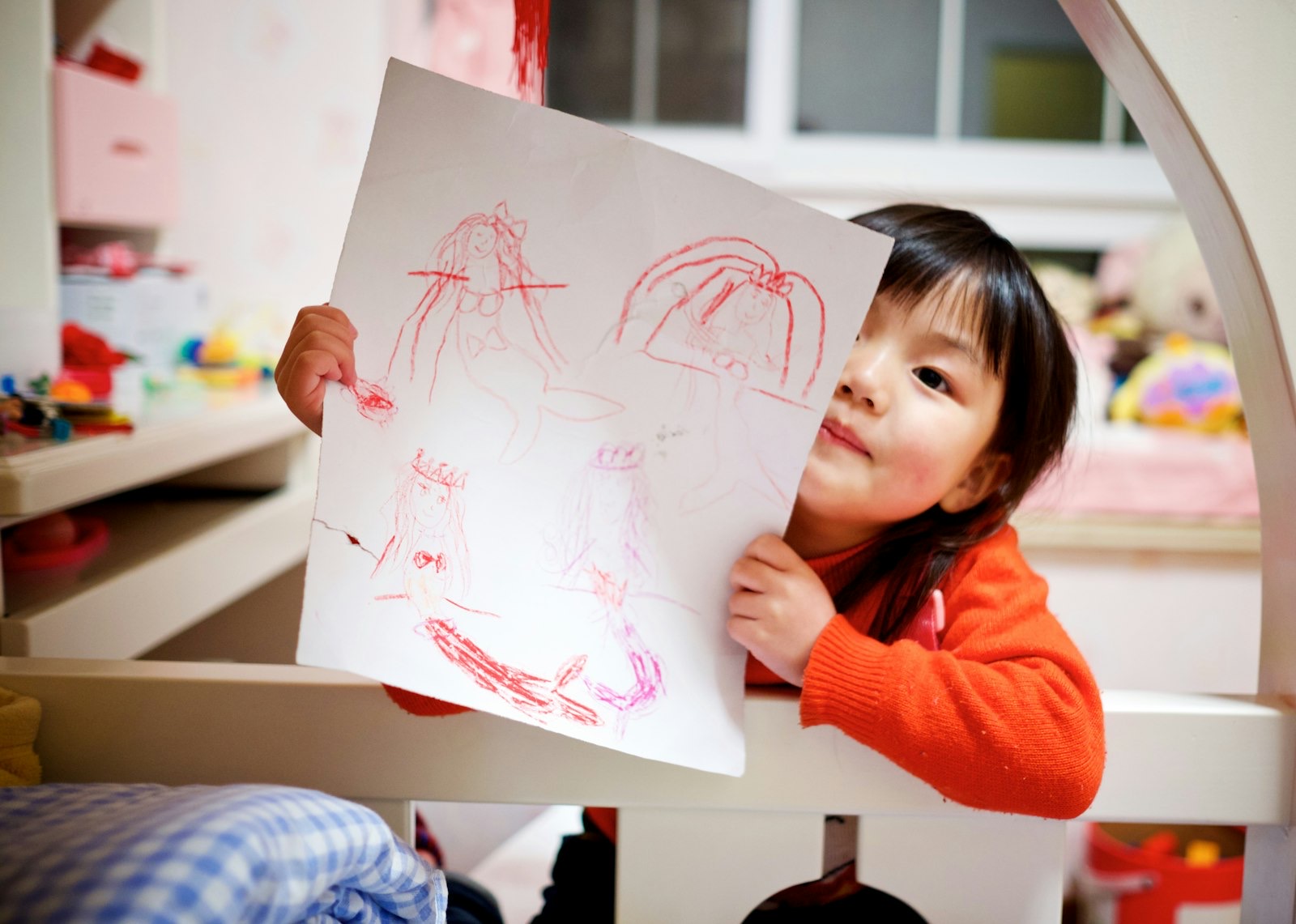
Houses, suns and rainbows: why every kid draws the same things
Square house, triangle roof, smiling sun. Why children everywhere settle on the same little set of symbols, and how to open up the repertoire without nagging.
8 min read
Stages of child art development, from first marks to realistic drawing
Scribbles, symbols, schemas and the wobbly leap toward realism. A rough map of how children's drawing changes, and what you can safely ignore.
9 min read
How to praise a child's drawing without killing their curiosity
Skip the automatic "it's beautiful". Here is what to say instead, with example lines for a three-year-old, a six-year-old and a nine-year-old.
8 min read