Drawing games for car trips and long train rides
By the Scribblie team · Published · 9 min read
In this guide
- The kit that makes the difference
- When drawing makes some children feel unwell
- Games that survive a bumpy road
- Train-specific ideas
- Noise management in the back seat
- A travel journal that outlasts the trip
- Quiet tools for tiny passengers
- Older children and the long haul
- Pack the bag at the door
- Common questions
The first rule of drawing in a moving vehicle is that the setup matters more than the idea. A child with a firm surface, a soft pencil and a single sheet will happily draw for half an hour. A child with a wobbly piece of paper on a soft knee will give up in ninety seconds and ask how long it is until we get there.
We start with the kit and the problem that affects some children (feeling queasy), then the games that survive a bumpy road, then noise, which is what decides whether a long trip goes well.
The kit that makes the difference
You need something hard to lean on. A clipboard is ideal, because it holds the paper in place. A hardback book or a tray with a lip will do, and so will a cut-down cardboard box. If you can, get a clipboard with a storage compartment under the lid, and keep the paper, pencils and a small eraser inside, so a whole drawing station fits in one hand.
Choose pencils and chunky crayons. Soft graphite pencils (a B or 2B) draw easily without pressing, so shaky lines do not matter. Crayons are fine in cool weather and can melt on a hot back seat, so keep them away from the sun. Avoid anything that leaks: ordinary markers, paint pens, and anything that can stain upholstery. Washable markers can work, but their caps do tend to roll under seats.
Sharp pencils in a moving car deserve a small rule. Use them seated and buckled in, keep them in a pencil case when not in use, and keep them away from the child's face when the car brakes. Younger children can use short, fat crayons, which are harder to hurt anyone with. For toddlers, avoid small parts altogether, and supervise.
And a tip that sounds trivial: tie the pencil to the clipboard with a bit of string. It is amazing how much trouble that saves.
When drawing makes some children feel unwell
Some children feel queasy when they look down at a page in a moving vehicle. Others are fine. We cannot predict which kind yours is, and it can change from trip to trip.
Watch for quietness, a pale face, a sudden grumpiness, or a child who says their tummy feels strange. Those are signs to put everything away, open a window if you can, and point them toward the horizon. A short break from drawing is not a defeat. Switch to an audio game, such as an "I spy" or a storytelling relay, and try again later.
If it is a regular problem, shorter drawing bursts help, as does drawing with the paper held up high on a book, so the eyes do not tilt so far down. Ask your child's doctor if the problem is severe or frequent. We are not going to give medical advice here, but you know your child, and the warning signs are usually clear.
On trains, the problem is often smaller, partly because of the table and partly because there is more to look at. But the same principle applies.
Games that survive a bumpy road
Not every drawing game suits a car. Anything that depends on neat lines, tiny details or an eraser will frustrate. The games below treat the shaking as part of the fun.
The shaky scribble. Ask the child to draw a very long line while the road is bumpy, and then turn the squiggle into something. A bridge, a mountain range, a very anxious snake. A bumpy road makes scribbles for you. This is a variant of the squiggle swap in our drawing games without screens guide, and it needs no preparation.
Draw what we just passed. After a landmark, such as a bridge or a cow field, the child draws it from memory. The second player draws it too. Compare. It is quietly good for memory, and children enjoy being the keeper of what they saw. If you are the driver, you do not play. Keep your eyes on the road.
Monster passengers. Draw a monster for each person in the car. A grandmother who is a hedgehog, a brother who is a vacuum cleaner. Keep it affectionate, and ask who gets to see the drawings.
Slow-motion line. This is a one-line game, but at the speed of a snail. Put the pencil on the paper and move it so slowly that it takes at least half a minute to draw a face. Quiet and surprisingly absorbing, and a good one for the end of a long day.
The road trip map. Draw a long thin route on a strip of paper. Add each place you pass as a small icon: a petrol station, a windmill, a pink house. By the end of the trip you have a map of the trip, and the child has a souvenir. If you are going somewhere special, let them draw the destination as they imagine it.
Draw the stop. At each stop, draw the thing they saw that was strangest. Not the best, the strangest. This is an easy rule to follow and one that gives interesting results.
Train-specific ideas
A train is a better place for drawing than a car, because the ride is smoother, there is a table, and a child can look out of the window without being buckled. That opens up a few things.
Window sketch: draw one thing you see out of the window, and then, thirty seconds later, add what you see at that moment. The scenery changes every few seconds, so the picture gradually fills with a collage of things that have gone by. A shorter, simpler version is a "speed drawing" game where you draw whatever flashes past in ten seconds.
Folded creatures and telephone pictionary work well on a table, because they are quiet and use little space. Our family drawing games guide has the rules for telephone pictionary, and the guide to the monster game has the folded-paper version.
Keep the area tidy. A tray or a clipboard on the table is neater than loose paper, and a zipped pencil case stops pencils rolling off. Be considerate of other passengers: keep the volume down, and no wet or messy materials on a shared table.
Noise management in the back seat
A drawing game that works for fifteen minutes and then collapses into shouting has not worked.
Boredom is the main cause. A child who is bored will find something to do, and it will not be what you want. So plan to swap activities before the interest dies. Fifteen to twenty minutes of one thing is plenty, and then go on to the next.
Give each child something of their own. If there are two or three in the back seat, they will quarrel over the pencil case. Pack a separate small kit for each, even if they are the same.
Use a snack as a reset. It is a very reliable way to restore order, and nothing on this page works better. Hand it over before the trouble starts, not after.
Keep one cooperative game in reserve. A long, shared drawing of the trip, a monster team, or a game where one child draws and the other guesses will absorb a lot of energy. Our guide to rainy day drawing activities covers a similar pacing idea, with a series of activities that hand over to each other.
And have an audio fallback. When everyone is tired of paper, a story tape, a song or a long game of "I spy" fills the gap. You do not have to win against the boredom. You only have to outlast it until you arrive.
A travel journal that outlasts the trip
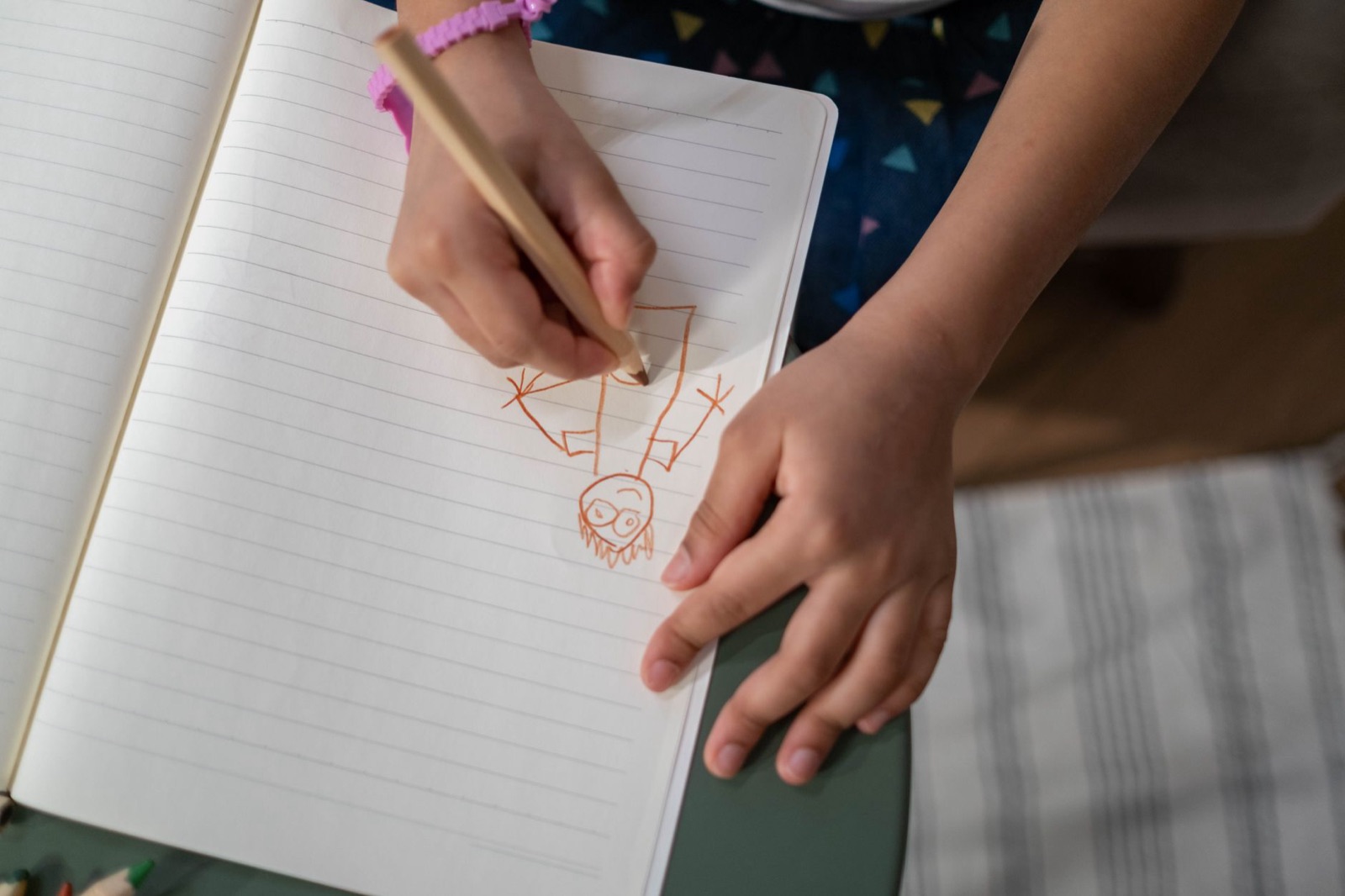
If the trip is more than a day, a small notebook turns scattered drawings into one object. Pick one that fits in a coat pocket and has a firm back, and let the child decorate the cover before you leave. Cover decorating is useful twice over: it gets them excited, and it tells them the book is theirs.
Then set one gentle rule: one page per stop, any kind of picture, and a date in the corner. A dull motorway service station is a perfectly good subject. So is a plate of chips, a stranger's dog, the carpet in the hotel. Children who are asked to draw only the highlights tend to feel that most of the trip was wasted, whereas a child who draws the chips has learned that everything is material.
Back at home, the journal is a good way to tell the story to someone who was not there. A grandparent on a video call can be shown the pages one by one, and the child narrates. If you want ideas for presenting the pages, see our piece on kids and grandparents drawing together.
Quiet tools for tiny passengers
For a toddler, the usual drawing tools do not suit a car seat. They cannot hold a clipboard, they will drop the pencil, and they may put things in their mouths. We would offer a few other options.
A water-reveal board, where a pen filled with water makes colour appear, is mess-free and reusable. A magnetic drawing board is similar. Sticker scenes are another reliable choice, in which a background is provided and the child adds stickers where they like. Fat crayons on a clipboard with large paper work for children who are a bit older, especially if a grown-up sits in the back and holds the board steady.
Whatever you choose, supervise anything with small parts, and keep sessions short. Many children of this age want novelty far more than skill, so be ready to produce something new every ten minutes. For ideas that suit very young children at home or in transit, see our guide to easy drawing ideas for 3 to 5 year olds.
Older children and the long haul
Older children can manage a longer project. A long trip is a good place for a comic strip, a detailed map of an imaginary country, or a sketchbook of things seen along the way. A ten-year-old with a good pencil and a clipboard may happily draw for an hour without asking for anything.
Challenges also suit them. Draw the passing scenery in a minute each, as if you were a reporter. Draw the same view three times in different styles. Draw a tiny, detailed version of a single thing, such as a fence post, in the time it takes to go through a village.
If you have a longer break coming up, the drawing prompts list has a stash of ideas for older children that need nothing but paper.
Pack the bag at the door
The most effective thing you can do is pack the bag before you leave, and put it somewhere the child can reach. A bag that is in the boot is no good. Put in a clipboard, six sheets, two pencils, a zipped case, a snack and one new item the child has not seen before. A new item can be as simple as a different colour of paper.
Then see how long the first game lasts. That tells you how to pace the rest of the trip.
Common questions
What are the best travel drawing games for kids?
Games that need one pencil and a small piece of paper, and that do not depend on neat lines. Eyes-open scribble transformations, "draw what you saw", and slow-motion one-line drawings all survive a bumpy road. Avoid anything that needs a ruler or fine detail.
What should I pack for road trip activities for kids?
A clipboard or hardback book to lean on, a few sheets or a small notebook, a pencil case with a zip, and a pencil sharpener you will not need. Pencils and chunky crayons are safer than markers. Keep it all in a bag the child can reach while buckled in.
Can drawing in the car make kids feel sick?
It can for some children. Looking down at a page while the car moves is a common cause of queasiness, so watch for quietness, pale skin or a request to stop. If it happens, put the paper away, look at the horizon, and try an audio game for a while.
How do I stop the back seat getting noisy?
Give each child a separate game with a turn-taking element, and keep one long cooperative game in reserve. Boredom is the main source of noise, so introduce a new activity before the fighting starts. A snack helps more than any rule.
What drawing games work on a train?
A train table makes things easier, so you can use almost any paper game. Folded-paper creatures, telephone pictionary and window-view sketches all work. Keep the table clear for other passengers, and avoid wet media.
What are good drawing games for toddlers on trips?
Sticker scenes, a magnetic or water-reveal drawing board, and a fat crayon with a clipboard. Keep sessions short and supervise anything small. Toddlers usually want novelty more than skill.
Keep reading
Easy drawing ideas for 3 to 5 year olds that need almost no setup
Drawing activities for little kids at home that start in under a minute, with notes on what to say, what to skip and when to stop.
9 min read
The draw-a-monster game: rules, variations and why kids love it
Three ways to play draw-a-monster, why children return to it again and again, and how to turn a scribble with eleven eyes into a story.
9 min read
Drawing games for kids that need nothing but paper and a pencil
Seven paper-and-pencil drawing games with the rules spelled out, the usual ways they go wrong, and a fix for each.
9 min read