Easy drawing ideas for 3 to 5 year olds that need almost no setup
By the Scribblie team · Published · 9 min read
In this guide
- The five-minute rule
- When you need a quiet ten minutes (while you cook)
- Tracing ideas: your hands, their hands, the cat
- Dot trails and wiggly paths
- Draw a pet (for the pet, or the toy)
- In the bath, in the car park, at the doctor's
- What to say (and not say) while they draw
- Making each idea fit a three, four or five year old
- Setting up a drawing corner in two minutes
- A tonight-sized plan
- Common questions
The easiest drawing activity for a small child is the one you can start before you have finished the sentence. Put a sheet of paper and a fat crayon in front of them, say "can you draw me a very long snake?" and sit down. That is the entire setup.
This guide is a collection of ideas for ages three to five that need almost nothing: paper, a few crayons, perhaps a cardboard box lid. We have organised them by the moment of the day when they tend to help, because the idea matters less than whether it suits the minute you are in.
The five-minute rule
Children this age have short, uneven attention. A three-year-old may draw for four minutes, wander off, and return an hour later with fresh interest. A five-year-old might sit for twenty if the idea is good.
So plan on five minutes and treat anything more as a bonus. If you try to stretch a session, the child learns that drawing is something that goes on until a grown-up says it stops, and that is not the lesson you want. End it while it is still fun. Pin the picture up, say "we can do more later", and mean it.
When you need a quiet ten minutes (while you cook)
You are at the stove and a small person is asking questions. The kitchen table, a crayon and a prompt that keeps them busy without needing you.
The long road. Tape a strip of paper, or two sheets joined, to the table. Ask for a road for toy cars from one end to the other. Roads are brilliant for this age because they are one continuous movement, which is a lovely way for a three-year-old to practise controlled lines without it feeling like practice. Park a real car on the finished road if you have one.
Food portraits. Ask them to draw what is for dinner. It will not look like dinner. It does not need to, and the conversation about what they think of it is half the fun.
Spaghetti. Draw one huge tangled loop with no lifting of the crayon, then ask them to find the one place where there is a face. Or just add two eyes and call it a monster. A scribble gets a second life when someone sees something in it, and that is one of the earliest tricks of imagination. For more on this stage, see our piece on the toddler scribble stage.
A word on supplies. Washable markers and chunky crayons are kinder to tables and small hands. Check the label for age suitability, and stay in the room with a child who still puts things in their mouth.
Tracing ideas: your hands, their hands, the cat
Tracing is where a bit of structure helps a child who is nervous of blank paper. The outline is already there, and the child gets to decide what it becomes.
Trace their hand with a crayon, fingers spread. Hold the paper steady and go slowly, which tickles. Then ask what the hand could be. Many children will see a turkey, a sun, a monster or a tree straight away, and if they do not, you can offer one and let them reject it. Rejecting your idea is a way of having their own.
Trace a foot. Trace a toy, such as a dinosaur or a spoon. Trace a leaf you picked up outside. Trace your own hand and let them turn it into a creature, and swap: they trace yours, you transform theirs. Children usually find the exchange hilarious, and it makes it clear that drawing is a game and not a performance.
An outline of the family cat sitting still is a rare thing. Trace a soft toy instead and call it the cat.

Dot trails and wiggly paths
You do not need a printed worksheet for dot-to-dot. Draw ten to fifteen dots yourself, big and spaced out, anywhere on a page, and ask the child to join them in any order they like. There is no hidden picture. The result is a surprise to both of you, and you can ask "what did it turn into?"
A few variations that work well. Draw a start and a finish, and ask for a path between them that goes around a lake you have scribbled in the middle. Draw a tiny house at one corner and ask them to draw the way the dog goes home. Draw a pond and ask for a trail of footprints for a duck, which is a good way of getting small repeated marks.
If your child is closer to five, you can count the dots as you go. Do it lightly, as part of the story, not as a lesson. They will tell you if they want to know what comes next.
Draw a pet (for the pet, or the toy)
Children love giving drawings away. Drawing something for someone changes the stakes, because there is a purpose and an audience, and the audience is not you.
Ask the child to draw a picture for the cat, the grandparent on the phone, the toy bear who is feeling poorly. "What would the bear like to look at?" is a different, easier question than "draw something". For this age group, an animal portrait made for a stuffed toy often turns out better than a picture made for a grown-up. The child is not being judged by the toy.
Another idea in this vein is to draw a pet that does not exist. Three eyes, five legs, tail on its head. Ask the child to name the creature and say what it eats. If you want to take this further into stories, our guide to story-starter drawing prompts has ready-made questions, and the drawing-prompts list by age has plenty more silly ones.
In the bath, in the car park, at the doctor's
Some of the best drawing happens in odd corners of the day.
Bath time: bath crayons exist, and so does a finger on a steamed-up tile. Check the product label and supervise, as always, near water. Draw a face on the misted mirror and let them add a hat.
Waiting rooms: a small notebook and a short pencil live in a bag. Ask for "a picture of everyone in this room, as animals". For safety, choose a pencil with a blunt end for very young children, and keep scissors and sharp things out of the bag.
Outside: a stick in damp sand or dirt, or chalk on a pavement, if you have somewhere safe to draw. The big movement of a whole arm is something many young children enjoy, because the line is as long as they are. Look for a few more ideas in our outdoor art guide when you are ready for them.
On the road: see our car trip drawing games for clipboard setups and motion-friendly ideas.
What to say (and not say) while they draw
The most common mistake with small children is asking "what is it?" It sounds friendly, but it puts the child on the spot and implies the drawing should look like something. If they say "a dog" and it looks like a lamp, you now have an awkward moment.
Try these instead: "tell me about your picture", "I see lots of red, did you like using that one?", "that line goes all the way across!" Describing what you actually see is respectful, and it keeps the child in charge of the meaning.
If you are not sure what to say about a finished picture, our short guide on how to praise a child's drawing is worth ten minutes.
One more tip. Do not offer to "fix" or finish a picture. Even a well-meant extra tree takes ownership away. If a child asks you to draw something, do it, but in the margin, on a different sheet, or next to them. And if they ask for your drawing to be like theirs, you are doing it right.
Making each idea fit a three, four or five year old
The same activity can stretch across the whole age band if you change one dial. With the hand outline, a three-year-old enjoys the tickle of being traced and scribbles inside the shape. A four-year-old might colour each finger a different colour and tell you who lives in each one. A five-year-old will often add eyes and a story to the whole hand and then ask to trace yours so they can make a family.
The road works the same way. The youngest will draw one long line, back and forth, and be proud. The middle child adds bumps, a bridge, a tunnel. The oldest in this band tends to decide the road has a name, a speed limit and a villain.
So when an idea seems too babyish or too hard, do not drop it. Make it simpler or add a rule. "Can you do it without lifting your crayon?" turns an easy task into a small challenge, and "can you do it with your other hand?" is good for five minutes of giggling.
What goes wrong at this age
The crayon ends up on the wall. It happens. Keep paper taped to the table so there is a clear place for it, and keep a damp cloth near. Moving the activity to the table or floor, on a big sheet, is often enough.
The child draws for one minute and leaves. That is a perfectly good session. Leave the paper where it is, and see if they come back.
They only ever draw one thing, such as the same circle with lines. Repetition is common in this phase and often means they are practising something. Our article on kids who draw the same thing over and over goes into it.
A five-year-old suddenly says they cannot draw. Take it seriously, but do not panic. It is a normal stage that many children go through, and it helps to keep the pressure off and the materials around.
Setting up a drawing corner in two minutes
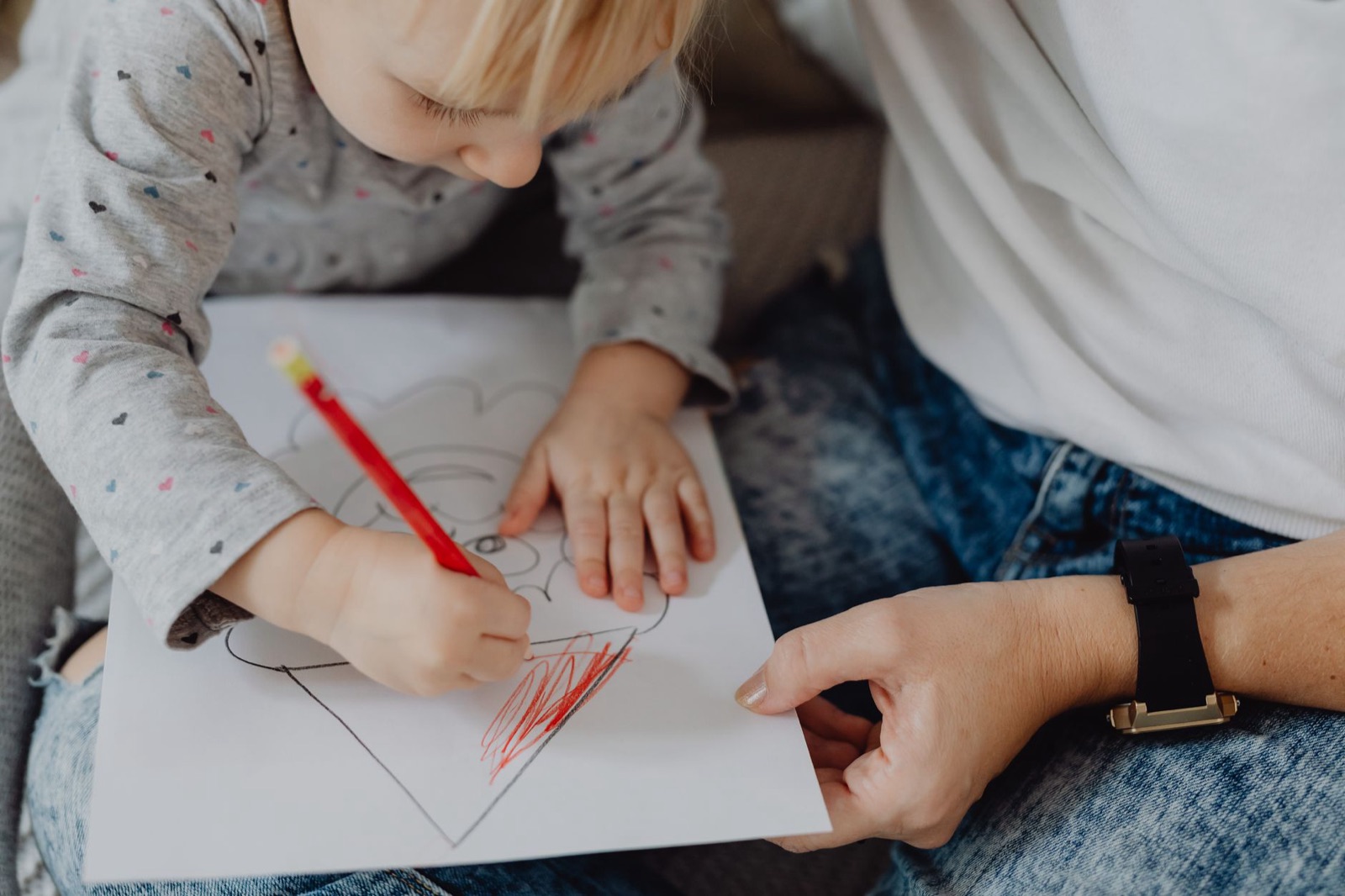
A tray or box is plenty: cheap paper, three or four chunky crayons or washable markers, kept where the child can reach it by themselves. Reachable matters more than neat. A drawer at child height beats a shelf you have to ask a grown-up to open.
Swap what is in the tray now and then. A new colour, a different size of paper, or a small card can start a whole afternoon, and costs almost nothing. For a fuller view of what is worth buying and what is not, see our art supplies starter kit.
A tonight-sized plan
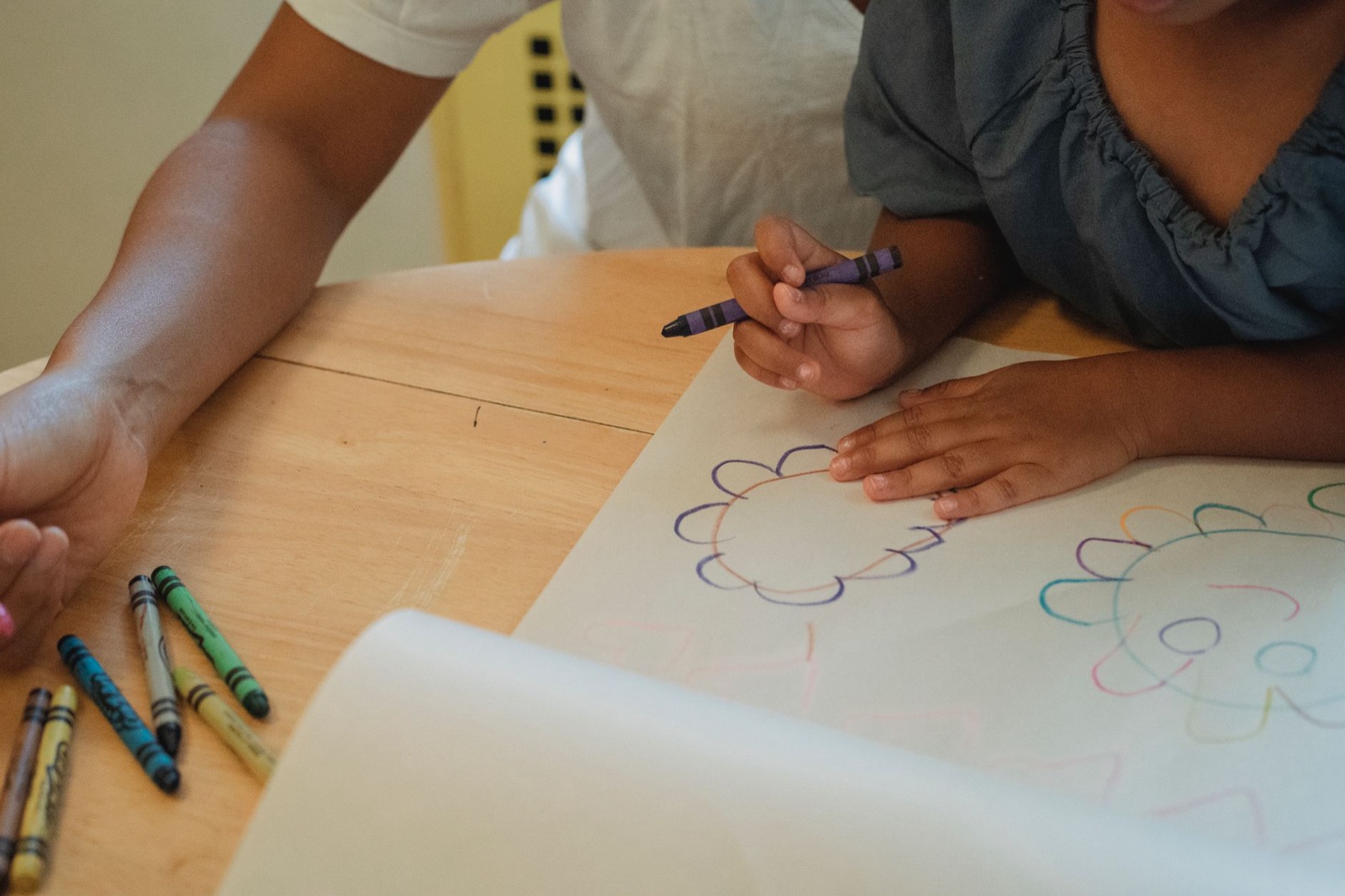
If you want something concrete to try this evening, here it is. Tape a long strip of paper to the table. Ask your child to draw a road. When it is done, ask where the road goes, and let them put in one house at the end of it. Then ask who lives there.
That is perhaps ten minutes. You have done a line exercise, a naming game and a story in one go, and you have not needed a single thing you did not already own. If they want to stop halfway, let them stop halfway.
Common questions
What are some easy drawing ideas for a 3 year old?
Trace their hand, draw a line for a snail to follow, or let them scribble a big pile of "spaghetti" and then add eyes. Three-year-olds enjoy the movement more than the result. Keep it to a few minutes and stay close.
How do I get my preschooler to draw at home?
Leave paper and two or three crayons somewhere reachable, and draw something yourself without announcing it. Many children join in out of curiosity. Pushing or praising too loudly usually has the opposite effect.
What do 3 year old drawing examples usually look like?
Often they are scribbles, loops, dots and lines, sometimes with a round shape that the child will name as a person or an animal. Some three-year-olds make early faces and some do not yet. All of this is within the wide range of normal.
What drawing activities for kids at home need no special supplies?
Paper, a crayon or washable marker, and a hard surface. A cardboard box lid works as a tray, and the back of an envelope works as paper. Almost everything on this page can be done with just those.
How long should a drawing activity last for a 4 year old?
Somewhere between five and fifteen minutes is common, and it varies a lot by child and mood. Stop while they are still interested. A short happy session beats a long tired one.
Should I show my child how to draw things?
You can draw alongside, but we would avoid correcting their marks or drawing their picture for them. Showing a simple shape, like a circle, when they ask is fine.
Keep reading
Drawing games for car trips and long train rides
A practical kit and a set of motion-friendly drawing games for car trips and train rides, with notes on queasiness, mess and the noise level in the back seat.
9 min read
Drawing prompts for kids, sorted by age (3 to 12)
Sixty-odd drawing prompts sorted into four age bands, with the reasoning behind each so you can invent your own when these run out.
9 min read
Nature art projects for kids using leaves, stones and mud
Leaf rubbings, stone faces, mud paint and stick frames, with notes on what to collect, what to leave alone and where each project goes wrong.
9 min read