Pretend play ideas that grow out of a drawing (shops, vets, restaurants and more)
By the Scribblie team · Published · 9 min read
In this guide
Give a child a pencil, some paper and ten minutes, and a drawing of a loaf of bread can become a bakery by lunchtime. The trick is to let the drawing come first. A child who has made a menu, a till or a sign has already decided who is in charge, what is on offer and what the rules are. Your job is to be the first customer. This guide has six games that start with drawn props, a few ways to make them last, and some notes on mess, scissors and tired grown-ups.
Why drawn props work better than bought ones
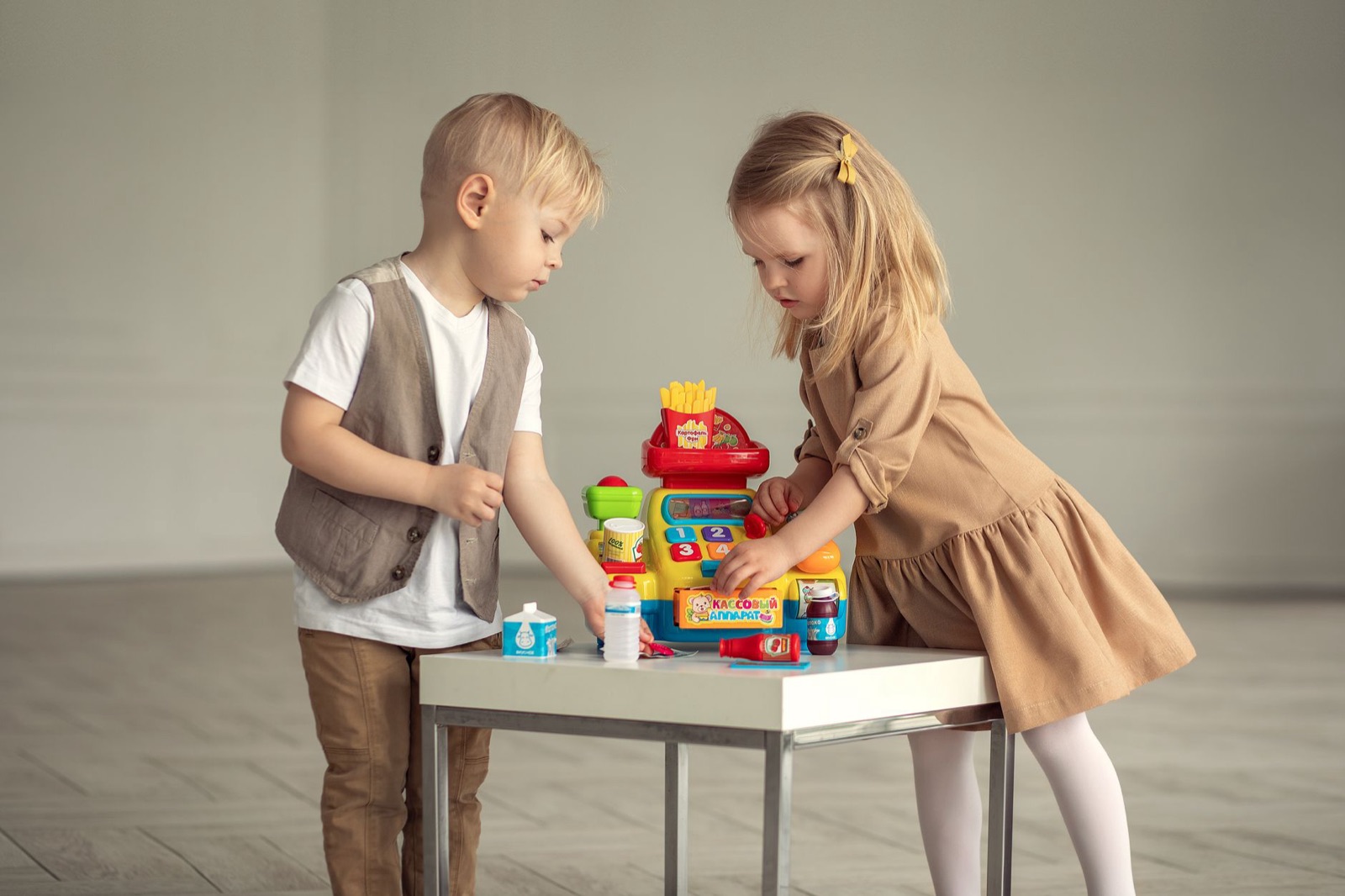
A plastic till is excellent, but it arrives finished. A paper till has to be made, and the making is half the game. The child decides what buttons it has, what the money looks like, whether it beeps.
There is also a small matter of ownership. A prop the child has invented is theirs to defend, and they will take the game seriously in a way that a borrowed set of toy food does not always inspire.
And drawn props are very forgiving. The apples can be square. The vet's stethoscope can be a wobbly circle on a string. Nobody needs it to look right, and any adult who hovers about realism will be gently ignored.
We would keep a small tin of supplies handy: plain paper, a pen or two, sticky tape, a few cardboard boxes and a tea towel. That is enough for almost everything below. If you want to build the kit slowly, our guide to art supplies for a starter kit has suggestions.
Six games to start with
Each of these starts with one or two drawings and needs no shopping.
Game one: the shop
This is the one most children already know, so it is a good place to start.
Ask what the shop sells. A child who draws vegetables will be a greengrocer. A child who draws only monsters will be running something more unusual, and you should buy a monster.
Draw the goods on small pieces of paper, one item each, and set them out on a table. Make price tags, even if the prices are "four" and "a hundred." Draw some money, round coins and rectangular notes, and cut them out if the child likes cutting. Scissors need supervision for younger children, and rounded-tip child scissors are the sensible choice.
Then play. You are a customer, and you have a problem. You want something that is not in stock. You have the wrong change. You want a very small cabbage.
The best shop games often turn into counting games and sorting games without anyone mentioning it. If your child enjoys the words, see drawing to learn new words, which has labelling games that fit a shop nicely.
Game two: the vet
A vet needs patients, and you already own several. Line up soft toys and ask the child to draw an appointment card for each, with the animal's name and what is wrong.
Draw a clipboard, a bandage (a strip of paper and tape does fine), a thermometer and a chart. The child examines each animal and decides on a treatment. Your job is to be the worried owner. "He won't eat his dinner" is a good opening line, and so is "he ate a sock."
This game is gentle and caring, and it is a good one for children who are a bit anxious about real doctors. Practising the other side of the appointment, as the one who looks after the patient, is something many children seem to enjoy. We would not claim it prepares them for a real visit, and a real-life worry about a check-up is best raised with the doctor.

Game three: the restaurant
Restaurants are the dependable favourite, because there is a lot to make. A menu, a notepad for taking orders, plates, a sign on the door, a bill.
Let the child draw the dishes on the menu. They will be wonderful. Dishes tend to be named with great ambition ("Super Sandwich With Everything") and priced at random.
Take the order seriously. Write down what you say, or ask the child to write it, in whatever form their writing takes. A page of squiggles is still an order. Then the "kitchen" prepares the food, which may be a drawing, a toy or a real piece of fruit.
The extension is the complaint. A customer who is not happy with the soup gives the waiter a chance to handle a small problem politely, which is a skill, and a funny one to watch a five-year-old try out. A script that sometimes works: "Excuse me, there is a spider in my soup." Wait and see what comes back.
Game four: the post office
Children enjoy the idea of letters, even if they rarely see them. Draw stamps, a postbox out of a shoebox, a sorting tray and a few envelopes.
The child writes or draws a letter to someone, a person or a toy or a character from a drawing, and the post office delivers it. You can be the postman, or the person who receives the letter and has to reply.
This one is good for children who like to write, or who are just starting. A drawn letter is a letter. If they want to dictate words for you to write down, you can do that too, without comment on spelling.
Grandparents are brilliant recipients. A real letter, posted, to a real person who will write back is a very great pleasure for a small child, and our page about kids and grandparents drawing together has more ideas along these lines.
Game five: the travel agent, or the expedition
Draw a map. It can be a treasure map, a map of the garden, a map of an imaginary island. Mark places with names the child chooses. Draw tickets, and a passport if they like.
Then go. The sofa is a ship, the hallway is a jungle. Your suitcase is a cushion. The child is the captain, and you are the nervous passenger who has forgotten the sandwiches.
This one scales up well for older children, who might make the map more detailed, invent rules and plan the whole trip before setting off. For ideas to feed the story side, story-starter drawing prompts has some good seeds.
Game six: the theatre of one drawing
Take a single drawing, a character the child made, and give it a small stage. A shoebox on its side makes a theatre. Cut out the character, or tape the drawing to a stick or a straw, and it becomes a puppet.
Let the character say something, or ask the child what it would say. Then have a conversation with it, you as the audience, the child as the voice. If you would like step-by-step help with the making, see our guide to paper puppets from your child's drawing.
A word on safety. Straws, sticks and scissors are all fine for most children with supervision, but they are pointed or small. Keep sticks short and blunt, supervise cutting, and for under-threes skip the small pieces altogether.
Costumes from a cardboard box
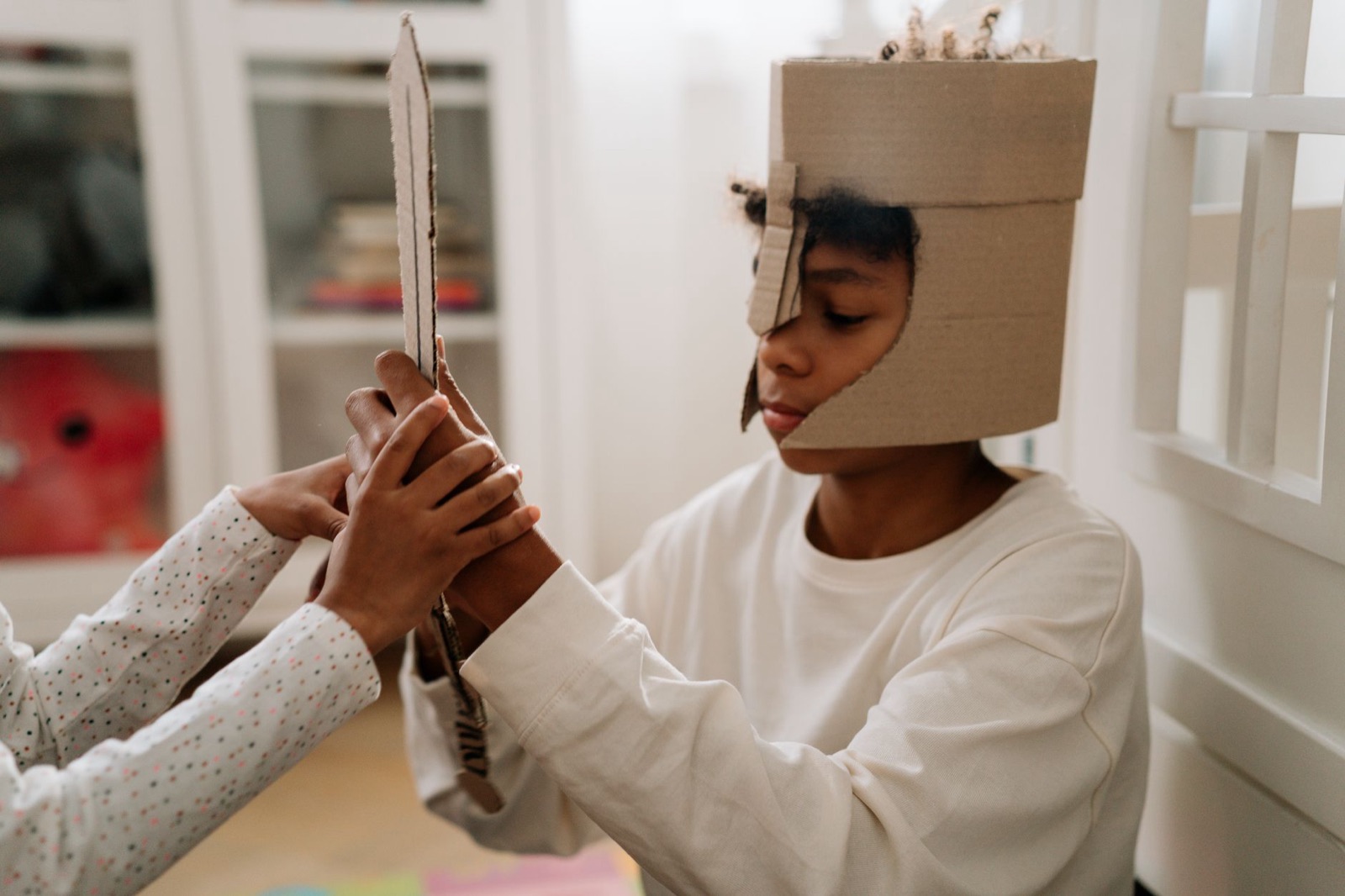
Props are half of it, and costumes are the other half. You do not need a dressing-up box. A cardboard box with armholes becomes a robot, a bus or a knight. A strip of card makes a crown, a tea towel makes a cape or a head scarf, and a drawn badge on a sticker makes a doctor, a police officer or a captain.
Let the child design the costume first, on paper. Ask what the character would wear, and what is the one thing they would never be without. The answer is often a hat, a belt or a pair of very large spectacles. Then make the one thing, not the whole outfit. A single drawn badge worn proudly will carry a game for an hour.
Cutting cardboard is a job for a grown-up, or a child with supervision and child-safe scissors. Smooth any rough edges with tape. Avoid masks that cover the whole face for younger children, since they can be frightening or hard to breathe in. Anything with elastic around the neck should be loose, and removed at once if it is tight.
If your child draws a character they love, such as a creature or a hero, a costume of that character is a very satisfying next step. See the monster-drawing game for a way to invent a few.
Making it last: the problem trick
A pretend game that is only setting up tends to collapse after twenty minutes. A game with a problem in it can go on much longer.
You can add a problem in your role. The till is broken. The patient is missing. A customer will not leave. A pirate has taken the postbox.
Or you can ask the child to introduce one. "What goes wrong in a restaurant?" is a question that most children can answer with great enthusiasm.
The aim is a bit like story spine, in miniature: someone wants something, something stops them, they try, it ends. We go through that shape in how to help your child tell stories, and it works nicely with moving bodies too.
Joining in without taking over
The hardest part of role play for many adults is the same as the hardest part of storytelling: letting the child run it.
Take the part they give you. If they say you are the dog, you are the dog. Resist the urge to improve the game, to correct the rules or to make it educational. If you want to add a bit of arithmetic, make it a request: "I would like three apples please." Do not turn it into a lesson.
Be a bit bad at things. A customer who cannot find their money is more fun than an efficient one.
Notice when the child is tiring of it, and wind it down before it falls apart. Ten good minutes is better than thirty drifting ones.
And if you are exhausted, say so. "I need a rest, the shop is closing for lunch" is a very good line.
Where Scribblie comes in
We are building an app called Scribblie, not yet in the stores. A child draws something, and the drawing wakes up and talks back. Some of the adventures are little scenes to play together, like a rainy day or a trip to the beach. We think of it as a small extra, rather than a substitute for any of the games above, and the child's drawn props and your own voice will always be more flexible than a screen. The friend's replies come from AI models and can occasionally be off. It is made for children of about five to eight. Details are in how Scribblie works.
For the next rainy afternoon
Pick one game, and one drawing. A rainy day is perfect, and we have more ideas in rainy day drawing activities. Say, "Shall we open a shop? What does it sell?" And then, whatever the answer, say, "I'd like to buy one, please."
Common questions
What are good pretend play ideas for a 4 year old?
Shops, vet clinics, restaurants and post offices are classics, because children have seen them and know the roles. Drawing the props first, such as a menu or money, gives the game a running start.
How do I start role play with my child?
Offer a small role and a small job, like "Would you like to be the shopkeeper? I'll be a customer who wants three apples." Then follow their lead and let them correct you, which they will enjoy.
Is pretend play important for children?
Many people who work with young children value it highly, and it is widely described as a natural, enjoyable way for children to practise talking, sharing and imagining other people. We would not promise particular results, but it is time well spent together.
What props do I need for role play for kids?
Hardly anything. Paper, a pen, a few boxes, some soft toys and a cloth are plenty, and drawn props often beat shop-bought ones because the child has invented them.
How can I make pretend play last longer?
Add a small problem, such as a customer with no money or a patient who will not open their mouth, and let the child solve it. Problems keep a game moving after the setting-up is done.
What if my child only wants to play the same game every day?
That is very common and usually harmless. Add one new element at a time, such as a new customer, and see whether the child takes it up.
Keep reading
Drawing to learn new words: simple vocabulary games for early readers
Pencil, paper and a handful of words. Eight low-prep vocabulary games for early readers, plus how to make them work for families who speak more than one language.
9 min read
Storytelling for kids: how to help your child tell stories without taking over
The hard part of helping a child tell a story is closing your own mouth. Here are the questions, the story spine and the small rituals that give the story back to them.
8 min read
How Scribblie Works: From a Drawing to a Friend Who Talks Back
A plain-English walk through Scribblie, the app we are building: how a drawing becomes a friend, what it remembers, what grown-ups control and where it can go wrong.
8 min read